Sapphire, Mineral, or Acrylic: Which Watch Crystal Is Best?
Billy Park
·
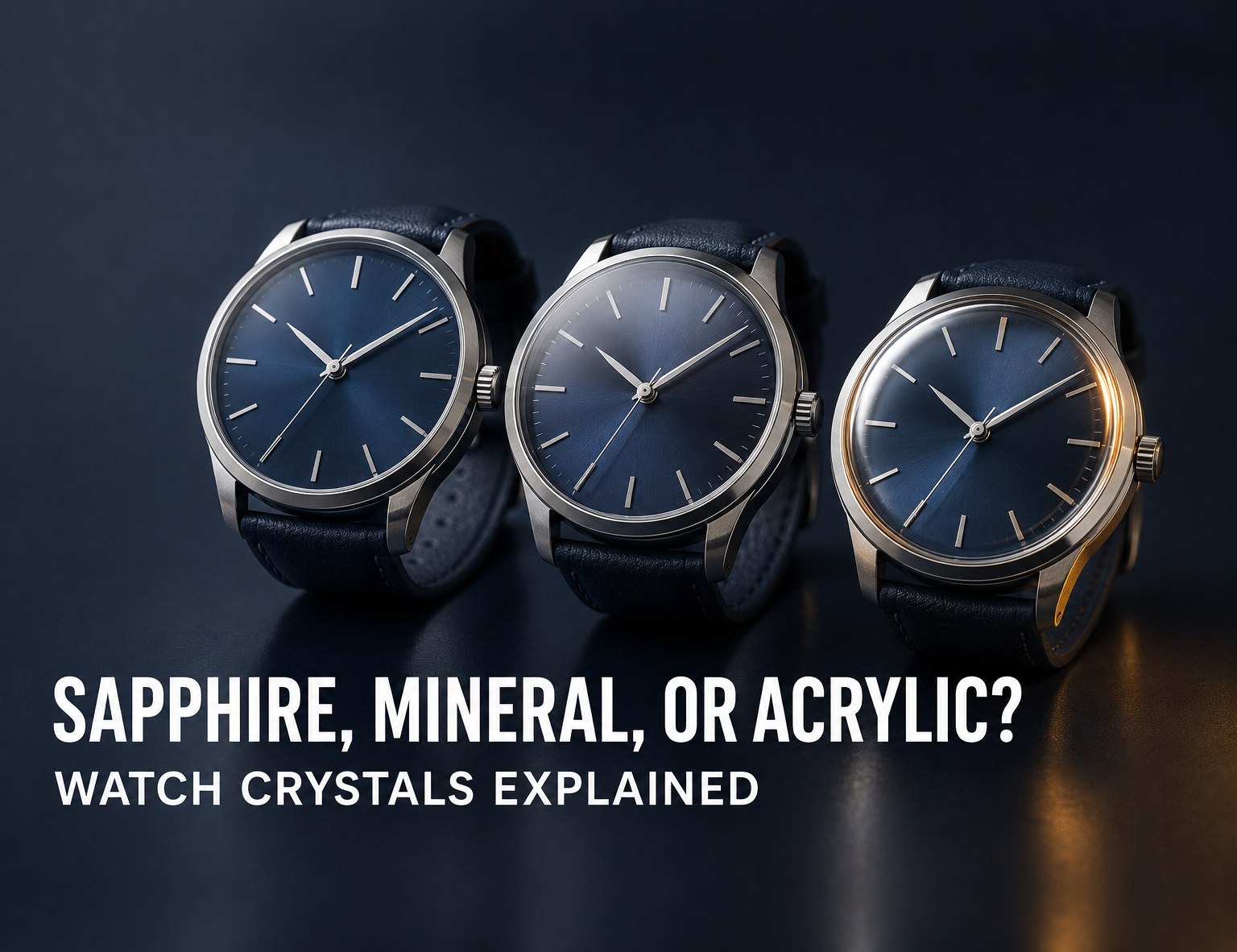
Buyers often compare the dial, case size, and movement while overlooking the transparent cover above them. The watch crystal protects the dial and hands, affects legibility, and influences how easily the watch can be maintained.
The three materials you will encounter most often are:
Sapphire crystal
Mineral glass
Acrylic crystal
There is no universal best choice. The answer depends on whether you prioritize scratch resistance, impact behavior, price, clarity, repairability, or vintage character.
What Does a Watch Crystal Do?
The crystal is the transparent cover that protects the dial and hands from dust, moisture, and impact. When comparing materials, consider four separate qualities:
Scratch resistance: How well the surface resists abrasion
Impact behavior: How the material responds to a hard strike
Legibility: How clearly the dial appears under reflections
Repairability: Whether scratches can be polished or the crystal must be replaced
Scratch resistance and impact resistance are not the same thing. A very hard material can resist surface marks while still chipping or breaking under a concentrated impact.
1. Sapphire Crystal: Best for Scratch Resistance
Watch crystals described as sapphire are generally made from synthetic sapphire, a form of aluminum oxide. Sapphire ranks 9 on the Mohs hardness scale, making it highly resistant to scratches from many objects encountered in daily life.
Advantages
Highest scratch resistance of the three common materials
Maintains a clean appearance over long ownership
Clear, premium visual character
Well suited to a daily watch you intend to keep
Disadvantages
More expensive
Can chip or break under a strong edge impact
Naturally reflective without good anti-reflective treatment
An external anti-reflective coating may scratch before the sapphire does
Sapphire is highly scratch-resistant, not indestructible. A strike against stone, tile, or a sharp desk edge can still cause damage.
Best for: Daily wearers who want the crystal to remain visually clean for years.
2. Mineral Glass: The Practical Middle Ground
Mineral glass is treated or strengthened glass adapted for watch use. It is more scratch-resistant than acrylic and usually less expensive than sapphire, which makes it common in affordable and mid-priced watches.
Brands may use proprietary names or strengthening methods. Seiko’s Hardlex, for example, is a hardened mineral crystal. Read the specification carefully for terms such as mineral, hardened mineral, or Hardlex.
Advantages
Good balance of price and everyday durability
More scratch-resistant than acrylic
Often less expensive to replace than sapphire
Widely used in practical entry-level watches
Disadvantages
Scratches more readily than sapphire
Deep scratches are usually more practical to address through replacement than polishing
Strengthening and quality vary by manufacturer
Best for: Buyers who want a sensible daily watch and prefer to put more of the budget toward the movement, design, or water resistance.
3. Acrylic Crystal: Easy to Scratch, Easy to Love
Acrylic is a transparent plastic rather than glass. It may also be described with terms such as Hesalite or Plexiglas. It is common on vintage watches and historically inspired reissues, where a raised dome creates warm distortion around the dial.
Advantages
Light and relatively flexible under impact
Less likely to shatter into sharp fragments
Light scratches can often be reduced with an appropriate polish
Creates an appealing vintage look
Disadvantages
Scratches more easily than mineral or sapphire
Accumulates fine marks over time
Requires care around strong heat and chemicals
May not satisfy buyers seeking a cold, perfectly clear modern appearance
Acrylic can look inferior on a specification sheet while being exactly right for a vintage design. Some owners view its developing marks as part of the watch’s history.
Best for: Vintage-watch enthusiasts, owners who like domed crystals, and people comfortable with occasional light polishing.
Sapphire vs. Mineral vs. Acrylic
Comparison
Sapphire crystal
Mineral glass
Acrylic crystal
Scratch resistance
Very high
Moderate
Low
Impact behavior
Hard but can chip under concentrated impact
Balanced general performance
Flexible and less prone to sharp shattering
Weight
Moderate
Moderate
Light
Typical price
High
Medium
Low
Light scratch restoration
Difficult
Difficult
Relatively easy
Common use
Premium and daily watches
Entry-level and practical watches
Vintage and heritage designs
These are general tendencies. Thickness, curvature, coatings, bezel protection, and case construction can change real-world performance.
Do Not Ignore Anti-Reflective Coating
Sapphire is highly scratch-resistant but can reflect enough light to obscure the dial. Manufacturers use anti-reflective, or AR, coating to improve legibility.
Inner-surface coating: protected from external abrasion and less likely to show coating scratches
Coating on both surfaces: can reduce reflections more effectively, but the outer coating is exposed to wear
When shopping online, look for wording such as anti-reflective coating, AR coating, or coating on the inner surface.
Which Material Fits Your Use?
Daily office and commuting
Sapphire is convenient when the watch may brush against desks, zippers, and door frames. It reduces the worry of fine surface scratches.
First watch or value-focused purchase
Mineral glass can be a sensible compromise if you would rather allocate your budget to the movement, case, water resistance, or design.
Vintage character
A domed acrylic crystal offers warmth and visual distortion that modern flat sapphire may not reproduce. Maintenance becomes part of the ownership experience.
Examine the surface under side lighting for fine scratches.
Inspect the edge for chips or cracks.
Ask whether marks are in the crystal or an external AR coating.
Look for moisture, dust, or stains beneath the crystal.
Confirm whether the crystal is original or has been replaced.
Estimate parts, labor, and water-resistance testing if replacement is needed.
On a vintage watch, collectors may prefer an aged original component over a visually perfect replacement. Judge the crystal in the context of the watch’s age and purpose.
How to Care for a Watch Crystal
Remove loose dust before wiping the surface.
Use a clean, soft cloth.
Do not store the watch in contact with metal bracelets or other watches.
Take care after beach use because sand can contain hard quartz particles.
Have deep scratches, chips, or cracks professionally inspected.
Polish acrylic only for light marks and only after checking the material and manufacturer guidance.
If a crystal cracks, stop wearing the watch and avoid operating the crown. Moisture or small fragments may enter the case, so arrange inspection promptly.
Final Thoughts
Choose sapphire if minimizing scratches is the priority. Choose mineral glass if you want a balanced, affordable everyday solution. Choose acrylic if vintage character, lightness, and repairability are part of the appeal.
The most expensive material is not automatically the best for every watch. Check the shape, coating, replacement cost, case protection, and the way you will actually use it.
Adapted from an original guide first published in Korean on Kairon Watch.
[…] The familiar contemporary Moonwatch Professional uses a 42 mm case and the hand-wound Co-Axial Master Chronometer Calibre 3861, which OMEGA describes as the most advanced evolution of the Calibre 321 that NASA astronauts wore on the Moon. Its appeal includes the ritual of winding it, the no-date display and the tactile operation of a mechanical chronograph. Buyers can also choose between historically evocative hesalite and sapphire-crystal configurations. […]
[…] but it is not the entire value of a mechanical watch. Durability, finishing, design, comfort, repairability, movement architecture, and history can matter just as much to an […]
To provide the best experiences, we use technologies like cookies to store and/or access device information. Consenting to these technologies will allow us to process data such as browsing behavior or unique IDs on this site. Not consenting or withdrawing consent, may adversely affect certain features and functions.
Functional
Always active
The technical storage or access is strictly necessary for the legitimate purpose of enabling the use of a specific service explicitly requested by the subscriber or user, or for the sole purpose of carrying out the transmission of a communication over an electronic communications network.
Preferences
The technical storage or access is necessary for the legitimate purpose of storing preferences that are not requested by the subscriber or user.
Statistics
The technical storage or access that is used exclusively for statistical purposes.The technical storage or access that is used exclusively for anonymous statistical purposes. Without a subpoena, voluntary compliance on the part of your Internet Service Provider, or additional records from a third party, information stored or retrieved for this purpose alone cannot usually be used to identify you.
Marketing
The technical storage or access is required to create user profiles to send advertising, or to track the user on a website or across several websites for similar marketing purposes.


Leave a Reply