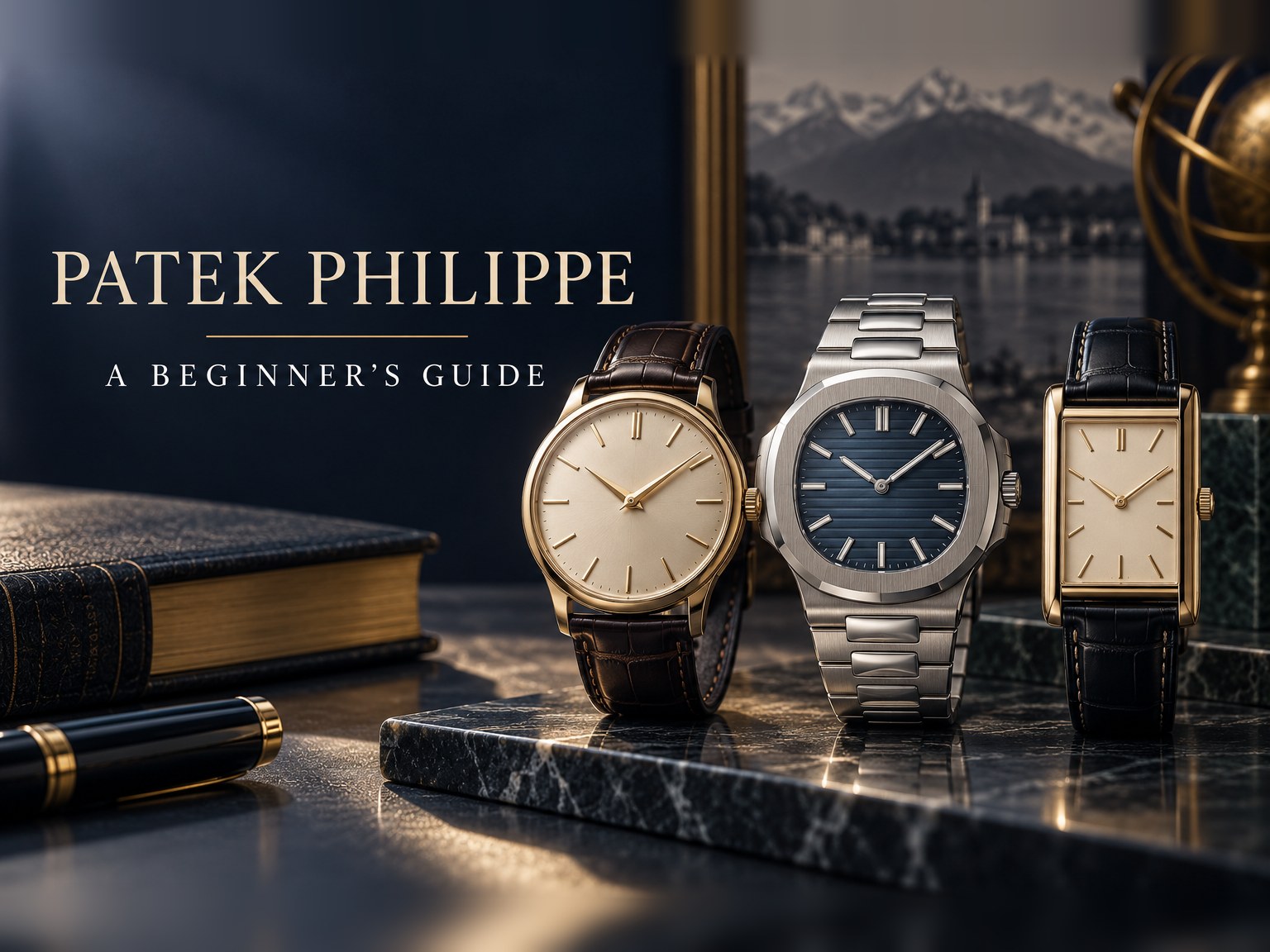
Patek Philippe Beginner’s Guide: How to Choose Your First Patek
Billy Park
·
This article discusses watch collections, buying routes and resale value in general terms for informational purposes only. It is not financial or investment advice — see our Financial Disclaimer.
Patek Philippe is often described as one of the most prestigious names in watchmaking. That reputation, however, can make the brand seem simpler than it is: a famous logo, a handful of unobtainable sports watches, and prices that dominate the conversation.
Look past the headlines and a much broader picture appears. Patek Philippe makes restrained dress watches, contemporary sports watches, shaped cases, travel watches, calendars, chronographs, minute repeaters, and some of the most complex portable timekeepers ever attempted. The right first Patek is therefore not automatically the most recognizable or most expensive one. It is the watch that fits your life, wrist, taste, and appetite for long-term ownership.
This guide explains the major collections, how to narrow the field, and what to check when buying new or pre-owned.
Availability, retail policies, and prices vary by market and change over time. Confirm current details with an authorized retailer before making a purchase.
What Makes Patek Philippe Different?
Patek Philippe traces its history to 1839 — the year its own archives begin. Today, its collection stretches from simple time-only watches to Annual Calendars, World Time watches, chronographs, perpetual calendars, and chiming Grand Complications.
The important point is that complexity is not the only measure of quality. A simple Calatrava can express the company’s design language just as clearly as a complicated calendar. The appeal lies in proportion, finishing, movement construction, continuity of design, and a long-term approach to service and restoration.
That last point matters. A high-horology watch is not merely an expensive object to acquire. It is a mechanical object that must be worn thoughtfully, insured appropriately, and serviced by qualified specialists. The ownership experience should be part of the buying decision from the beginning.
The Main Patek Philippe Collections
Calatrava: The Classic Dress Watch
Patek Philippe describes the Calatrava as “the quintessential round wristwatch with pure lines.” Its identity is built around balanced dials and traditional case shapes rather than conspicuous sport styling.
Why consider it:
It is one of the clearest expressions of traditional Patek Philippe design.
Its restrained character tends to age well.
It works naturally with tailoring, formalwear, and professional settings.
What to consider:
A thin precious-metal dress watch may not suit an active, casual routine.
Water resistance and strap durability can be more limited than on a sports model.
Subtle differences in dial, bezel, lugs, and movement matter more than they first appear.
For a buyer who wants one refined watch rather than the most visible status symbol, Calatrava is often the most logical place to start.
Nautilus: Sporting Elegance
The Nautilus is known for its rounded-octagonal bezel, horizontally organized dial designs, and integrated-bracelet architecture. It helped define the idea of a luxury sports watch that could move between leisure and sophisticated settings.
Its fame creates a potential trap: buying the market narrative instead of the watch. Before focusing on desirability or resale value, compare case size, thickness, metal, dial layout, complications, bracelet fit, and total weight. A watch that is iconic in photographs is not automatically comfortable on your wrist.
Aquanaut: Casual, Modern, and Travel-Friendly
The Aquanaut made its debut in 1997, and Patek Philippe describes its case and rounded octagonal bezel as reminiscent of the Nautilus. The embossed dial and composite strap give it a younger, more relaxed identity.
Aquanaut can make sense for travel and frequent casual wear. Examine the strap carefully: condition, cut length, replacement options, and fit are all relevant, especially on a pre-owned example. Also check the functions. A simple date model and a Travel Time or chronograph version deliver very different ownership experiences.
Cubitus: A Contemporary Sporting Shape
Cubitus is the newest arrival, introduced in 2024 with what Patek Philippe describes as a square-shaped case with rounded edges and a dial carrying horizontal relief embossing. Its angular architecture and integrated bracelet give it a strong wrist presence.
Do not judge a shaped watch by width alone. Case length, thickness, corner geometry, first-link articulation, and the flatness of your wrist all influence fit. Cubitus is a collection to try on, not one to select from specifications alone.
Golden Ellipse: Proportion and Restraint
The Golden Ellipse sits between a circle and a rectangle. Its appeal is not based on tool-watch functionality; it is about shape, proportion, thinness, and a minimalist dial.
For someone who finds conventional round dress watches too predictable—but does not want the visual weight of an integrated-bracelet sports watch—the Golden Ellipse offers a distinctive alternative.
Gondolo: The Art Deco Spirit
Gondolo brings together rectangular and cushion-shaped “form” watches. It draws on Art Deco geometry and Patek Philippe’s history of shaped cases. These watches are especially compelling for collectors who view a watch as an object of design as much as an instrument.
Twenty~4: From Day to Night
Twenty~4 launched in 1999 as Patek Philippe’s first collection made exclusively for women. It now covers two genuinely different ideas, which the brand sets out plainly: an Art-Deco-inspired “manchette” cuff design with a quartz movement, and a round case with a self-winding movement — the Twenty~4 Automatic, added in 2018.
In other words, the collection should not be reduced to “a quartz Patek” or assumed to be entirely mechanical. Case shape, movement type, setting, bracelet, and intended use need to be compared model by model.
Complications and Grand Complications
The Complications collection includes useful and expressive mechanisms such as Annual Calendars, World Time displays, and chronographs. Grand Complications represents the most demanding side of the manufacture, including mechanisms such as perpetual calendars and minute repeaters.
More functions mean more to learn. Setting procedures can be precise, and servicing is generally more involved than it is for a simple time-only watch. Choose a complication because you will use or appreciate it—not merely because it sits higher in a hierarchy.
Choosing the Right First Patek
Primary use
Collections to explore first
Why
Business and formal wear
Calatrava
Thin, restrained, and classically proportioned
Travel and casual daily wear
Aquanaut
Relaxed design and travel-oriented options
Sporting elegance
Nautilus, Cubitus
Integrated design and stronger wrist presence
Artistic individuality
Golden Ellipse, Gondolo
Distinctive proportions and shaped cases
Mechanical functions
Complications
Calendars, travel time, chronographs, and more
Day-to-night versatility
Twenty~4
Jewelry character and two movement/case concepts
Ask yourself five questions before choosing a reference:
How often will I realistically wear it?
Will it spend more time with tailoring, business casual clothing, or travel wear?
Do I want a pure time display or a function I will actually use?
Am I comfortable with the weight and vulnerability of the chosen metal and finish?
Can I support the insurance, storage, and service needs over many years?
These questions usually produce a better shortlist than starting with social-media popularity.
Fit: More Than a Diameter
Patek Philippe makes round, rectangular, elliptical, cushion-shaped, and angular watches. Comparing all of them through a single diameter number is misleading.
When trying one on, check:
whether the lugs or first bracelet links extend beyond your wrist;
whether the crown presses into the back of your hand;
whether the watch slides comfortably under a cuff;
whether the dial remains legible at a natural viewing distance;
whether the weight of steel, gold, or platinum feels balanced;
and whether the bracelet or strap can be adjusted without compromising comfort.
Use a mirror and look from a step away. Close-up phone photos often exaggerate a watch’s size. Wear it while seated and while walking, and make sure the clasp position is comfortable underneath your wrist.
Buying New
Use Patek Philippe’s official points-of-sale directory to verify that the seller is authorized. Policies and allocations can differ, so treat anything you have heard about waiting lists as market-specific rather than universal.
At purchase, confirm the warranty terms, box, documents, accessories, and any spare bracelet links. Record what was supplied and store the paperwork separately and securely. Do not allow urgency around a hard-to-find model to replace ordinary due diligence.
Buying Pre-Owned: Provenance Before Price
A pre-owned Patek Philippe should be evaluated as a watch, a set of documents, and a chain of ownership. At minimum, review:
the seller’s history, return policy, and authenticity guarantee;
consistency among the reference, case, movement, and documents;
case edges, bezel geometry, and signs of excessive polishing;
dial, hands, crown, bracelet, and movement for replaced or refinished parts;
recent service documentation and likely future service needs;
One practical note on inspection: the movement number is engraved on the movement and the case number inside the case back, so reading them means opening the watch — work Patek Philippe says should only be done by an authorized retailer or service center. Do not let an eager seller open a case on a kitchen table.
Certificate of Origin vs. Extract from the Archives
These two documents are often confused.
The Certificate of Origin is delivered with a new watch. The point that matters most to a pre-owned buyer is Patek Philippe’s own position on replacing one: it “can unfortunately never be re-issued.” A missing certificate is therefore permanent, and no seller can promise to obtain a replacement later.
An Extract from the Archives is a different document. It transcribes what Patek Philippe’s archives — which date back to 1839 — record about a specific watch, including its key features and its date of sale. Under the current conditions, a timepiece is eligible only if it was first sold at least ten years before the request, the request can be made once a year for the same watch, and it costs 500 Swiss francs.
Neither document substitutes for the other, and neither one by itself establishes the watch’s present condition. A complete set of papers can accompany a problematic watch, while an authentic watch can have lost its original documents. Authentication, condition, and provenance have to be evaluated separately.
Service Is Part of the Purchase Price
Patek Philippe’s care guidance is specific: quartz and mechanical watches with manually wound and self-winding movements should be serviced every eight to ten years through an official service center or authorized retailer. Actual needs can vary with use, water-resistance condition, shocks, magnetism, and the complexity of the movement.
A complicated watch may require more time and expense to service than a simple three-hand model. Build insurance, secure storage, routine testing, and future service into the total cost of ownership.
Polishing also deserves a deliberate decision. Repeated or aggressive refinishing can soften edges and alter the architecture of a case. With an older or collectible watch, preservation may matter more than making every surface look new. Agree on the scope of cosmetic work before service begins.
Patek, Auctions, and What Actually Holds Value
Some Patek Philippe references have achieved strong secondary-market prices. That does not mean every Patek appreciates, nor does it make any watch a guaranteed investment. Patek Philippe itself declines to give valuations, directing owners to auction houses or specialist dealers instead.
Returns can be affected by acquisition price, dealer spread, auction or platform fees, insurance, service, taxes, currency movements, condition, and changing taste. A watch that looks profitable on a price chart can deliver a much less impressive result after ownership costs.
A more durable first-watch test is:
Would I still want this design if its market premium disappeared?
Will I actually wear it?
Do I understand and enjoy its functions?
Can I maintain it properly?
Am I buying through a channel I trust?
If the answers are yes, potential value retention becomes a benefit rather than the entire reason for ownership.
Buying Your First Patek Without Regret
Patek Philippe is much broader than the Nautilus. Calatrava represents classical restraint; Aquanaut offers modern casual character; Cubitus brings a more angular sporting identity; Golden Ellipse and Gondolo explore proportion and shape; and the Complications families express the manufacture’s technical depth.
For a first purchase, evaluate the decision in this order:
wearing purpose;
case shape and fit;
movement and functions;
purchase channel and provenance;
long-term service responsibility.
The best first Patek is not necessarily the one with the highest market price. It is the one you can understand, wear, and care for over a long period of time.
Chapter2 is not affiliated with, endorsed by or sponsored by Patek Philippe SA. Collection, document and service details were checked against Patek Philippe’s own published information on the date of publication and can change.
To provide the best experiences, we use technologies like cookies to store and/or access device information. Consenting to these technologies will allow us to process data such as browsing behavior or unique IDs on this site. Not consenting or withdrawing consent, may adversely affect certain features and functions.
Functional
Always active
The technical storage or access is strictly necessary for the legitimate purpose of enabling the use of a specific service explicitly requested by the subscriber or user, or for the sole purpose of carrying out the transmission of a communication over an electronic communications network.
Preferences
The technical storage or access is necessary for the legitimate purpose of storing preferences that are not requested by the subscriber or user.
Statistics
The technical storage or access that is used exclusively for statistical purposes.The technical storage or access that is used exclusively for anonymous statistical purposes. Without a subpoena, voluntary compliance on the part of your Internet Service Provider, or additional records from a third party, information stored or retrieved for this purpose alone cannot usually be used to identify you.
Marketing
The technical storage or access is required to create user profiles to send advertising, or to track the user on a website or across several websites for similar marketing purposes.


Leave a Reply