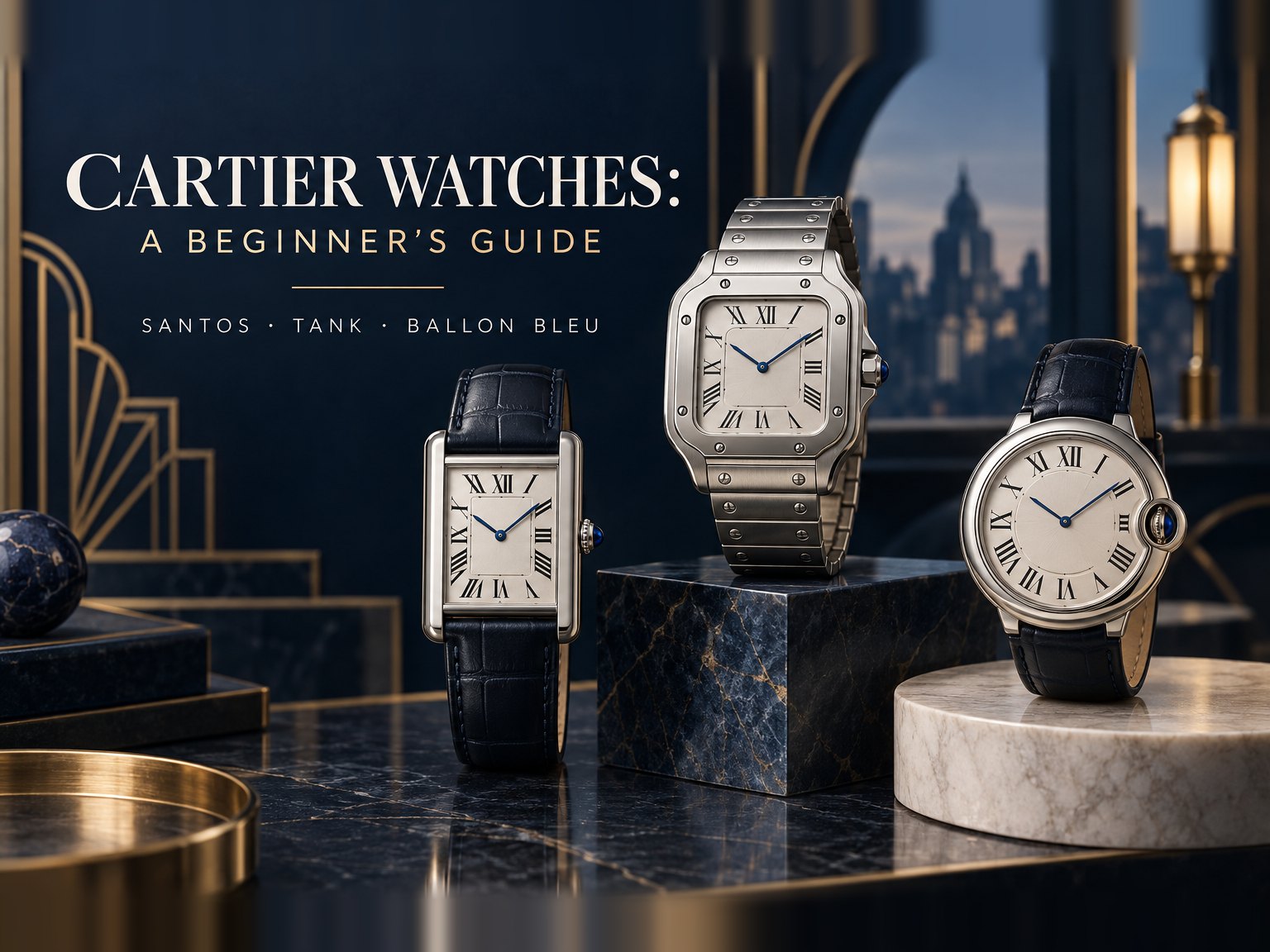
Cartier Watches: A Beginner’s Guide to Santos, Tank, Ballon Bleu and More
Billy Park
·
This article discusses watch collections, buying routes and resale value in general terms for informational purposes only. It is not financial or investment advice — see our Financial Disclaimer.
Is Cartier a jewelry house that happens to make watches, or a serious watchmaker with an exceptional eye for design?
The most useful answer is that it is both. Cartier has shaped the visual language of the wristwatch through proportion, geometry, and recognizable details. Its watches are not defined by one case shape or one type of movement. The collection ranges from slim quartz dress watches to automatic everyday pieces and highly complicated creations.
That breadth can make a first purchase confusing. A Santos and a Tank may share Roman numerals and blued hands, yet they feel completely different on the wrist. The Ballon Bleu is familiar and round, while the Panthère behaves almost like jewelry.
This guide explains how to choose among them without treating price, scarcity, or resale value as the only measures of quality.
Why Cartier Watches Matter
Many watch brands build their identity around movement architecture or tool-watch performance. Cartier’s greatest strength is its command of shape. Rectangles, squares, softened circles, exposed screws, integrated bracelets, and cabochon-set crowns become part of a consistent design vocabulary.
Several features appear across the catalog:
Roman numeral hour markers
Railroad-style minute tracks
Sword-shaped blue hands on many references
Beaded or cabochon-set crowns
Carefully controlled case and dial proportions
These details are recognizable, but they do not make every Cartier interchangeable. The right collection depends on how you dress, how often you wear a watch, whether you prefer a bracelet or strap, and how much maintenance you want.
Cartier’s Core Watch Collections at a Glance
Santos de Cartier: The Versatile Sporty Classic
Cartier says the Santos de Cartier watch “perpetuates the pioneering spirit of aviator Alberto Santos-Dumont.” Its square case and visible bezel screws give it a stronger, more architectural presence than a conventional dress watch.
Modern Santos de Cartier models work particularly well as all-purpose watches. A steel bracelet can look polished with a jacket but relaxed with knitwear or a polo shirt. On applicable references, Cartier’s bracelet and strap systems make it easier to change the character of the watch without tools.
Do not choose a Santos from case width alone. A square watch fills more visual space than a round watch of a similar stated dimension, and the first bracelet links affect how it sits on a smaller wrist. Medium and large versions can therefore wear more differently than their measurements suggest.
Best for: Someone who wants one Cartier for the office, travel, dinners, and weekends.
Tank: Cartier’s Essential Dress-Watch Design
The Tank is one of the most influential rectangular watches ever made. Cartier’s own account is unusually direct about where it came from: the watch “was created by Louis Cartier, who designed it after the tanks of WWI battlefields,” and it is “defined by flat vertical brancards and a sapphire cabochon.” Those brancards — the vertical sidebars — visually connect the case and strap, which is why a Tank reads as architectural rather than ornamental.
“Tank” is a family rather than a single model. The Tank Must offers an accessible expression of the design. The Tank Louis Cartier is more traditional and typically associated with precious-metal cases. The Tank Française emphasizes its bracelet, while the Tank Américaine uses an elongated, curved profile.
A Tank does not need to dominate the wrist. Its elegance often comes from wearing slightly smaller than a typical sports watch. Instead of relying on gender labels, compare the case length, width, and strap proportions against your wrist and wardrobe.
Best for: Tailoring, formal occasions, minimalist clothing, and buyers who value a timeless silhouette.
Ballon Bleu de Cartier: Rounded and Approachable
The Ballon Bleu offers a softer route into Cartier. Its round case feels familiar, while the crown sits inside a protective curve of the case rather than projecting from it. That detail gives the watch an unmistakable profile without the sharper geometry of the Santos or Tank.
Different sizes can change its role dramatically. Smaller versions can read as jewelry; larger versions feel more like conventional wristwatches. Because the case and bracelet flow together smoothly, the Ballon Bleu can move between business and casual settings with little effort.
Best for: Someone who wants recognizable Cartier design in an elegant, rounded form.
Panthère de Cartier: A Bracelet That Tells Time
The Panthère is best understood as both a watch and a piece of jewelry, and Cartier makes no secret of it: the Maison calls it “an iconic watch that takes its name from its bracelet,” whose “ultra-flexible structure echoes the movement of the Maison’s emblematic animal,” and describes it plainly as “the ultimate jewelry watch.”
The watch head is deliberately compact, allowing the bracelet to remain the visual focus. It works well alone or layered with understated jewelry. Movement specifications are usually less important to the Panthère buyer than comfort, finish, and styling versatility — many references are quartz.
Best for: Buyers who prioritize jewelry presence, tactile comfort, and effortless styling.
Pasha de Cartier: Check Availability Before You Fall for It
The Pasha has a round case, assertive lugs, and a distinctive crown-cap treatment. It looks more extroverted than the Ballon Bleu and less familiar than the Santos or Tank.
One practical caveat worth knowing before you start shopping. At the time of writing, Cartier’s United States site does not list a Pasha watch collection page — the collection URL redirects to the general watches listing, and a site search for “Pasha watch” returns three results, two of which are fragrance bottles and one a high-jewellery piece. Availability varies by market and changes over time, so confirm directly with Cartier for your country.
In practice this means that for most buyers the Pasha is currently a pre-owned proposition rather than a boutique purchase. That is not a reason to avoid it, but it does change the checklist: condition, originality and service history matter more when you cannot simply buy new.
Best for: Buyers who want a less common Cartier design and are comfortable shopping pre-owned.
Which Cartier Fits Your Life?
One watch for almost everything: Santos
Tailoring and formal wear: Tank
Soft, versatile, round design: Ballon Bleu
Jewelry-first styling: Panthère
Bolder and less conventional: Pasha, mainly pre-owned
Your existing wardrobe is a better guide than a popularity ranking. If you mostly wear suits and dress shirts, a slim Tank may receive more wrist time than a larger sports watch. If your week shifts between meetings, travel, and casual weekends, the Santos is usually easier to integrate.
For rectangular and square watches, do not rely on diameter comparisons. Check the full case length, how the corners sit within the wrist, whether the first bracelet links flare outward, and whether the crown presses against the back of your hand. Also try the watch under a shirt cuff.
Quartz or Mechanical?
Cartier is one of the brands where “mechanical is always better” is an especially weak rule. Quartz movements can support the thinness, compact dimensions, and convenience that make many Cartier designs successful — Cartier lists quartz models across the Santos, Tank and Panthère lines, not only at the entry point.
Choose quartz if:
You rotate among several watches.
You value grab-and-go accuracy.
You prefer a smaller or thinner case.
Design and jewelry character matter more than movement interaction.
Choose mechanical if:
You expect to wear the watch frequently.
You enjoy the experience of a mechanical movement.
The specific case size and collection you want are available with an automatic or hand-wound caliber.
You accept periodic maintenance and potentially higher service costs.
If you are weighing the two in general terms, our guide to automatic versus quartz movements covers the trade-offs in more depth. Some references use alternative technologies such as SolarBeat. Always confirm the exact movement, charging guidance, water resistance, and service requirements for the individual reference rather than applying a collection-wide assumption.
Steel, Gold, or Two-Tone?
Steel is usually the easiest material for frequent wear and a broad wardrobe. Yellow or rose gold intensifies Cartier’s jewelry identity and can make a small watch feel more substantial. Two-tone works particularly well on the Santos and Panthère because it highlights bezel, screw, or bracelet details.
Material also changes ownership cost. Gold scratches and dents differently from steel, and refinishing requires judgment. Diamond-set pieces require verification of whether the stones and setting are factory original. On a pre-owned watch, aftermarket diamonds can significantly affect collectability, service options, and resale value.
Before You Buy: New, or Pre-Owned?
Buying New
Try at least two adjacent sizes in the same collection.
Confirm bracelet adjustment range and every included strap or accessory.
Review warranty registration, return, and exchange terms.
Verify the exact case material, movement, water resistance, and gem setting for the reference.
Ask what registering the watch adds. Cartier operates a Cartier Care programme alongside its International Limited Warranty; the cover and the period depend on your market and the individual piece, so confirm the current terms at the point of sale rather than relying on a figure quoted online.
Buying Pre-Owned
Check the seller’s identity, reputation, return policy, and authentication promise.
Match the serial and reference information across the watch, papers, and sales documentation where applicable.
Inspect case geometry. Heavy polishing can soften a Tank’s brancards or round off a Santos bezel and screw details.
Check bracelet stretch, missing links, clasp operation, and the cost of obtaining replacements.
For quartz watches, look for evidence of battery leakage or circuit problems. For mechanical watches, ask about timing performance and service history.
Check the watch against loss and theft records. Cartier registers its watch creations with Enquirus, which allows lost and stolen items to be reported — a step worth taking before money changes hands.
Treat box and papers as supporting evidence, not proof of authenticity by themselves.
On vintage pieces, have a knowledgeable professional evaluate refinished dials, replacement hands, crowns, and other service parts.
Cartier’s pre-owned value varies by collection, size, metal, condition, completeness, and fashion cycles. Recognizable designs such as the Santos and Tank often appeal to a wider audience, but that does not mean every reference retains its retail price or appreciates.
A healthier decision framework is to ask:
Will I still want to wear this design in five years?
Does it work with most of my wardrobe?
Can I accept insurance, servicing, and repair costs?
Would I still enjoy it if its resale value declined?
A watch can be culturally important and emotionally valuable without being a reliable financial investment.
Final Recommendation: Which Cartier Should Be Your First?
For the broadest everyday use, start with the Santos. For a pure dress-watch expression, choose the Tank. If you prefer a softer round case, consider the Ballon Bleu. If jewelry presence is the priority, the Panthère is the clearest choice. The Pasha suits someone who wants more individuality and is willing to shop pre-owned.
Most importantly, try the watch on. Cartier’s designs are controlled by proportion more than headline specifications. The best model is not necessarily the largest, most expensive, or most complicated one. It is the one that looks natural on your wrist and keeps returning to it.
Chapter2 is not affiliated with, endorsed by or sponsored by Cartier. Collection availability, movement specifications, warranty terms and service policies vary by country and reference, and were checked against Cartier’s own published information on the date of publication.
To provide the best experiences, we use technologies like cookies to store and/or access device information. Consenting to these technologies will allow us to process data such as browsing behavior or unique IDs on this site. Not consenting or withdrawing consent, may adversely affect certain features and functions.
Functional
Always active
The technical storage or access is strictly necessary for the legitimate purpose of enabling the use of a specific service explicitly requested by the subscriber or user, or for the sole purpose of carrying out the transmission of a communication over an electronic communications network.
Preferences
The technical storage or access is necessary for the legitimate purpose of storing preferences that are not requested by the subscriber or user.
Statistics
The technical storage or access that is used exclusively for statistical purposes.The technical storage or access that is used exclusively for anonymous statistical purposes. Without a subpoena, voluntary compliance on the part of your Internet Service Provider, or additional records from a third party, information stored or retrieved for this purpose alone cannot usually be used to identify you.
Marketing
The technical storage or access is required to create user profiles to send advertising, or to track the user on a website or across several websites for similar marketing purposes.


Leave a Reply