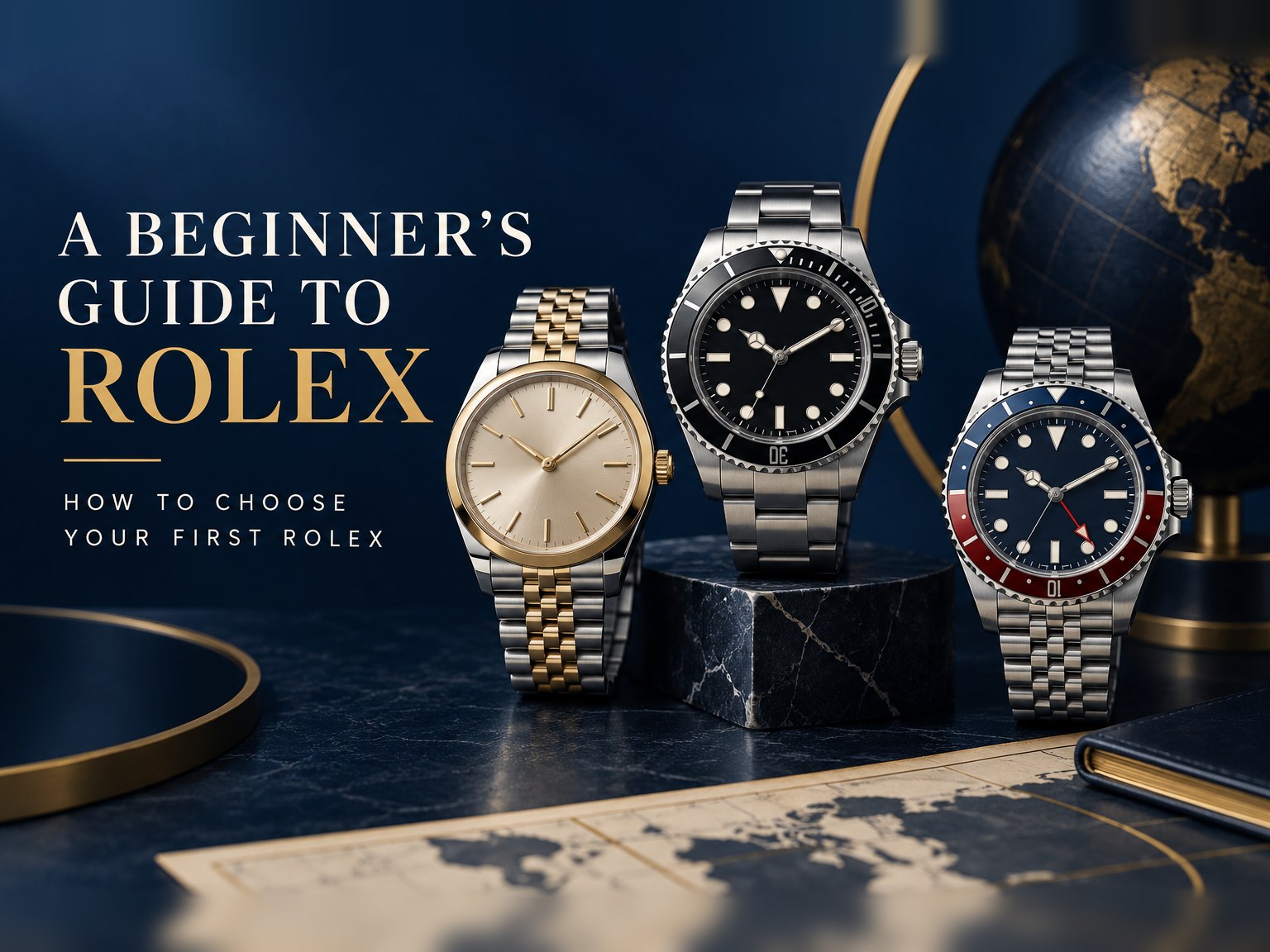
This article discusses watch collections, buying routes and resale value in general terms for informational purposes only. It is not financial or investment advice — see our Financial Disclaimer.
Rolex is one of the few watchmakers recognized far beyond the watch community. That familiarity can make the brand appear easy to understand—until you try to choose one.
Should your first Rolex be a Datejust or an Oyster Perpetual? Is a Submariner more versatile than an Explorer? Does the GMT-Master II make sense if you rarely travel? And should you pursue a new watch, a Rolex Certified Pre-Owned watch, or an ordinary pre-owned example?
The most popular Rolex is not automatically the best Rolex for you. A satisfying choice depends on your wardrobe, wrist, required functions, preferred materials, budget and tolerance for the risks of the secondary market.
This guide explains the brand’s practical appeal, compares six major collections and gives you a disciplined way to make your first purchase.
What Rolex Actually Sells
Rolex’s reputation rests on more than a crown logo or social recognition. Much of its history is tied to making a wristwatch dependable in everyday life.
Introduced in 1926, the Oyster case was a major step in protecting a wristwatch from water and dust. Rolex’s own account of that watch names three founding achievements—precision, waterproofness and self-winding—and the modern collection is still built around them. Over the following decades, Rolex developed a durable visual and technical language around legible dials, robust cases and practical bracelets.
The degree of water resistance and the available functions still vary considerably by model, so specifications should always be checked at reference level rather than assumed from the brand name.
For a buyer, the brand’s appeal usually comes from four things:
- Distinctive designs that evolve slowly rather than following short trends
- Cases, crowns and bracelets designed for regular wear
- Collections with clearly defined purposes
- Broad global recognition and an established service and resale ecosystem
Classic and Professional: A Useful Starting Point
Rolex offers many collections, but a simple distinction makes the range easier to navigate.
Classic-leaning watches
The Oyster Perpetual, Datejust, Day-Date and Perpetual 1908 move easily between business attire and everyday clothing. Dial, bezel, metal and bracelet choices can make two versions of the same collection feel remarkably different.
Professional-leaning watches
The Submariner, GMT-Master II, Explorer, Cosmograph Daytona and Sea-Dweller began with activities such as diving, aviation, exploration and motorsport. Functional bezels, strong luminous displays and more assertive cases often define their appearance.
These are not strict dress codes. A Submariner can be worn with a suit, while a Datejust can be a relaxed daily watch. What matters is not only what a model was designed to do, but how it will fit your life now.
Six Rolex Collections to Know

Oyster Perpetual: The Cleanest Starting Point
The Oyster Perpetual is a time-only Rolex with no date window or rotating bezel. Its simplicity places the focus on proportion, dial color and everyday wearability.
Best for: a clean first mechanical watch, minimal design and owners who do not want to reset a date.
Consider: it may feel understated if you want the more decorative or visibly “Rolex” cues of a fluted bezel, Cyclops lens or ceramic sports bezel.
Datejust: The All-Rounder
The Datejust combines a date display and Cyclops magnifying lens with an unusually wide range of dials, bezels, metals and bracelets. It can look restrained, celebratory, sporty or formal depending on its configuration.
Best for: one watch that needs to cover work, dinners, weekends and travel.
Consider: a fluted bezel, Jubilee bracelet and two-tone metal create a much stronger visual statement than a smooth-bezel steel configuration.
Explorer: The Understated Tool Watch
The Explorer emphasizes legibility and simplicity. It belongs to the Professional family but avoids a complex external bezel, allowing it to sit comfortably between casual and business settings.
Best for: buyers who value utility and restraint more than decoration.
Consider: if you want visible complications or a highly decorative dial, its simplicity may feel too quiet.
Submariner: The Dive-Watch Icon
Launched in 1953 as Rolex’s first divers’ wristwatch, waterproof at the time to 100 metres, the Submariner is now waterproof to 300 metres and uses a unidirectional rotatable bezel with a highly legible luminous display. Buyers can choose between the time-only Submariner and the Submariner Date, introduced in 1969.
Best for: a recognizable sports watch, strong water resistance and a design that works far beyond diving.
Consider: it has substantial wrist presence, and the real-world path to popular configurations varies by retailer, market and time.
GMT-Master II: Travel and a Second Time Zone
A 24-hour hand and a 24-hour graduated rotatable bezel allow the GMT-Master II to display two time zones simultaneously. The complication has practical value for frequent travelers and anyone coordinating across countries.
Best for: international travel, cross-border work or regularly tracking another time zone.
Consider: bezel colors and bracelet combinations attract their own market followings. Choose the configuration you want to wear, not merely the nickname receiving the most attention.
Cosmograph Daytona: The Motorsport Chronograph
The Daytona combines a chronograph for measuring elapsed time with a tachymetric bezel. Its motorsport history, visual identity and demand give it exceptional cultural weight.
Best for: buyers who genuinely enjoy chronograph design and the model’s racing story.
Consider: the dial is busier, availability can be difficult, and you may be paying heavily for an identity even if you rarely use the complication.
Match the Watch to the Job
| Your priority | Start with | Why |
|---|---|---|
| A simple first Rolex | Oyster Perpetual | Clean, time-only design and broad versatility |
| One watch for work and social occasions | Datejust | Many configurations and a wide formality range |
| A quiet Professional model | Explorer | High legibility without a complex bezel |
| Water and outdoor use | Submariner | 300 m water resistance and dive-timing bezel |
| Travel and international work | GMT-Master II | Simultaneous display of two time zones |
| A statement chronograph | Cosmograph Daytona | Elapsed-time function and unmistakable design |

Choose Size by Proportion, Not Status
Case diameter is only one part of fit. Bezel width, visible dial area, lug shape, case thickness and the articulation of the first bracelet links all affect how a watch sits on the wrist.
When trying one on, check whether:
- The lugs remain within the top surface of your wrist
- The crown presses uncomfortably into the back of your hand
- The proportions look balanced in a mirror, not just in a close-up phone photo
- The watch needs to pass beneath a shirt cuff
- The sized bracelet keeps the case centered rather than pulling to one side
A 36 mm watch is not inherently too small, and a 41 mm watch is not inherently more impressive. The right size supports the character you want without making the watch physically distracting.
Oystersteel, Rolesor or Precious Metal?
Oystersteel
Steel is generally the easiest material to integrate into daily life. It is durable and relatively restrained, but it is not scratch-proof. Polished center links and broad polished surfaces will show wear differently from brushed finishes.
Rolesor
Rolesor is Rolex’s name for combining steel and gold. It balances the practicality of steel with the warmth and visibility of gold. Try it against your skin tone and normal clothing; the effect can be far stronger in person than online.
Gold and platinum
Precious-metal watches offer unmistakable weight, color and presence. Consider not only the purchase price, but also how you feel about surface marks, insurance exposure and future service costs.
Buying a New Rolex
The standard route for a new Rolex is an Official Rolex Retailer. Rolex says new and genuine watches are sold exclusively through these retailers, who warrant authenticity, provide model and technical guidance, and prepare the watch before you leave with it—winding it fully, setting the time, date and day, checking its functions and verifying that the crown is tight. New watches bought this way carry a five-year international guarantee.
Contacting a retailer does not guarantee immediate access to every configuration. Inventory and sales practices can vary by store, market and time. Treat online waiting-time stories as individual experiences, not universal rules.
Before you shop, define:
- The exact collection, size and metal you would most like to own
- Your maximum all-in budget
- One or two alternatives that serve the same purpose
- Whether paying a secondary-market premium would meaningfully improve your experience
- Your plan for insurance, routine checks and eventual service
Buying a Pre-Owned Rolex
Authenticity is essential, but it is not the only question. A genuine watch can still contain later service parts, have heavily polished case geometry or require expensive movement and bracelet work.
Use this checklist:
- Verify the seller’s identity, reputation, return terms and written warranty.
- Confirm that reference and serial information are consistent with the watch and documents.
- Inspect the case edges and lugs for excessive polishing or uneven geometry.
- Ask about replaced dials, hands, bezels, bracelets and service components.
- Test timekeeping, power reserve, date change and chronograph or GMT functions as applicable.
- Do not infer water resistance from appearance; request a recent pressure test if water use matters.
- Treat box and papers as value factors, not proof that every component is authentic or correct.
Rolex’s Certified Pre-Owned programme covers second-hand Rolex watches that are at least two years old and offered by Official Retailers that have joined the programme. Rolex says these watches are authenticated in its own workshops, fully serviced, and sold with a distinct seal, a guarantee card and a two-year international guarantee. The price can be higher than an ordinary pre-owned example, but the programme provides a useful benchmark for buyers who prioritize brand-backed authentication and warranty coverage.

What Rolex Certified Pre-Owned Actually Guarantees
Rolex is the only maker in this series running its own factory-backed pre-owned programme, so it is worth knowing precisely what the seal buys you — and what it does not.
Under Rolex Certified Pre-Owned, a watch goes back to Rolex’s own workshops. Rolex is blunt about why that matters: “Only Rolex can confirm the authenticity of a Rolex watch.” The watch’s original configuration is verified “right down to its smallest gear trains” — which is the part an independent dealer, however reputable, cannot replicate.
A certified watch is authenticated, fully serviced and tested, then issued with a distinct seal and a brand guarantee card, and carries a two-year international guarantee.
What that does not do is settle price. RCPO stock is generally dearer than the same reference from a grey dealer, and the programme says nothing about whether a given model is a sensible buy. It removes authenticity risk and service risk. It does not remove the risk of overpaying, and it is not a valuation.
Rolex as an Asset: A Reality Check
Some references have appreciated strongly, and Rolex benefits from a liquid global collector market. Neither fact makes every Rolex a dependable investment.
Historical premiums do not guarantee future returns. Your actual result is affected by the spread between buying and selling prices, dealer fees, tax, currency movement, service costs, condition and completeness.
For a first Rolex, a better final question is:
Would I still want to wear this watch if its market price stopped rising?
If the answer is yes, the watch can continue to deliver its intended value even when the market changes.
Choosing Your First Rolex: The Short Version
Choose your first Rolex in this order:
- Decide whether you truly need a date, second time zone or chronograph.
- Choose between a classic or more overtly professional character.
- Try multiple sizes and configurations on your wrist.
- Compare the appearance and ownership costs of steel, two-tone and precious metal.
- Evaluate the risks and costs of new, Rolex Certified Pre-Owned and independent pre-owned routes.
- Ask whether you would keep wearing the model through a market decline.
Rolex offers enough variety to reward a personal choice. The difficulty is that rankings, nicknames and premiums can obscure it. The best Rolex is the one that fits your wrist, wardrobe and actual life.
Adapted from an original guide first published in Korean on Kairon Watch. Chapter2 is not affiliated with, endorsed by or sponsored by Rolex SA. Model details were checked against Rolex’s own published information on the date of publication and can change.
Sources and Further Reading
- Rolex — The Oyster Story
- Rolex — Watch Collection
- Rolex — Submariner
- Rolex — GMT-Master II
- Rolex — Purchasing a Rolex
- Rolex — Certified Pre-Owned
- Rolex — The RCPO Certification Process


Leave a Reply