Osaka: Japan’s Loudest, Hungriest, Most Lovable City
Billy Park
·
There is a saying in Japan that perfectly captures the spirit of the country’s two great old cities: Kyoto dresses up, Osaka eats. Kyoto is refinement — temples, ceremony, silence, the careful arrangement of things. Osaka is appetite — loud, generous, irreverent, and perpetually hungry. Where Kyoto whispers, Osaka shouts. Where Kyoto bows politely, Osaka grabs you by the shoulder, laughs directly into your face, and hands you a skewer of something extraordinary.
Where Tokyo impresses with precision and Kyoto enchants with refinement, Osaka grabs visitors by the hand, shoves a stick of takoyaki into it, and says “eat.” This is the city that invented the concept of kuidaore — eating yourself into ruin — and it wears that reputation as a badge of honor. Middle East Council on Global Affairs
This is Osaka. And once it gets hold of you, it never quite lets go.
🏙️ The Character: What Makes Osaka, Osaka
To understand Osaka, you have to understand its history — because history here is not dusty or academic. It lives in the streets.
Historically known as tenka no daidokoro — the nation’s kitchen — Osaka served as Japan’s commercial and culinary capital for centuries. During the Edo period, rice from across the country flowed through Osaka’s waterways, making it the economic engine of a nation. That mercantile DNA shaped a culture fundamentally different from the warrior traditions of Tokyo or the aristocratic elegance of Kyoto. Osakans are traders, comedians, and cooks. They greet each other not with “how are you” but with mokarimakka — “are you making money?” Middle East Council on Global Affairs
That is not a joke. That is an actual greeting. And it tells you everything.
Kuidaore isn’t just about gluttony. It’s a philosophy. It’s the city’s heart and soul served on a paper plate. Eating in Osaka is rarely a quiet, solitary affair. It’s a social, boisterous, and joyful experience, often shared with friends over a chorus of “Oishii!” and a round of laughter. The city’s funny bone is directly connected to its stomach. Center for American Progress
👨👩👧 The People: Japan’s Most Approachable Humans
If you have spent time in Tokyo, the people of Osaka will genuinely surprise you.
Osakans are famously direct, boisterous, and quick to laugh. Strangers might strike up a conversation while you wait for the traffic lights to change. Unlike the reserved elegance of Kyoto or the immense scale of Tokyo, Osaka’s identity is built on a foundation of joyful, down-to-earth human connection. This connection comes alive through its food, its famous comedy scene, and its unique language, Osaka-ben. Inspo Outfits
The manzai comedy tradition — a rapid-fire style of stand-up involving a straight man and a funny man — isn’t confined to the stage. Its witty banter and playful teasing rhythms shape everyday conversations. Strangers might start a conversation while you wait for your takoyaki. The shopkeeper in the shotengai won’t just sell you vegetables — they’ll ask about your day and offer unsolicited yet often insightful advice. Integrity Energy
If you say something a little silly or nonsensical, don’t be surprised if a local friend or even a stranger playfully calls you out on it. This isn’t intended to criticize — it’s a form of connection, a way of saying: “I’m listening and engaged.” This interactive, participatory humor is what makes the city feel so vibrant and welcoming. It breaks down social barriers and turns everyday moments into opportunities for shared laughter. Wikipedia
Many say Osaka has retained far more of its historical look, feel, and character than Tokyo. Osaka may not be as well-known, rich, or flashy as Tokyo, but Osakans will tell you it is a more real, honest, friendly, and earthy place — with a deeper history and a richer sense of humor. Many of Japan’s funniest comedians are from Osaka. Many say it is the heart of Japan. Oxford Economics
🏯 Places to Go: The Essential Osaka
Dotonbori — The Sensory Centre of the Universe
Dotonbori is the beating, neon-lit, mechanically-crab-waving heart of Osaka — and nothing prepares you for your first time standing on Ebisu Bridge looking down the canal at the wall of lights, signs, and giant moving sculptures that line both banks. It is maximalism as urban planning. It is Las Vegas if Las Vegas had better food and more soul.
Dotonbori is ground zero for Osaka’s signature dishes. The best stalls have a visible griddle where you can watch cooks deftly turn each takoyaki ball. Wanaka near the Glico sign and Aizuya — considered the birthplace of takoyaki — are local favorites. Dotonbori also serves excellent gyoza with crispy wings at Osaka Ohsho, ikayaki grilled squid pressed flat, and butaman pork buns from 551 Horai, whose steaming red boxes are an Osaka institution. Daily Front Row
The Glico Running Man sign — a backlit figure of an athlete crossing a finish line — is Osaka’s answer to the Eiffel Tower. Every visitor photographs it. Every local uses it as a meeting point. Walk the canal both directions, eat constantly, and stay until the neon reflects gold on the water.
Osaka Castle — Warlords, Cherry Blossoms, and Panoramic Views
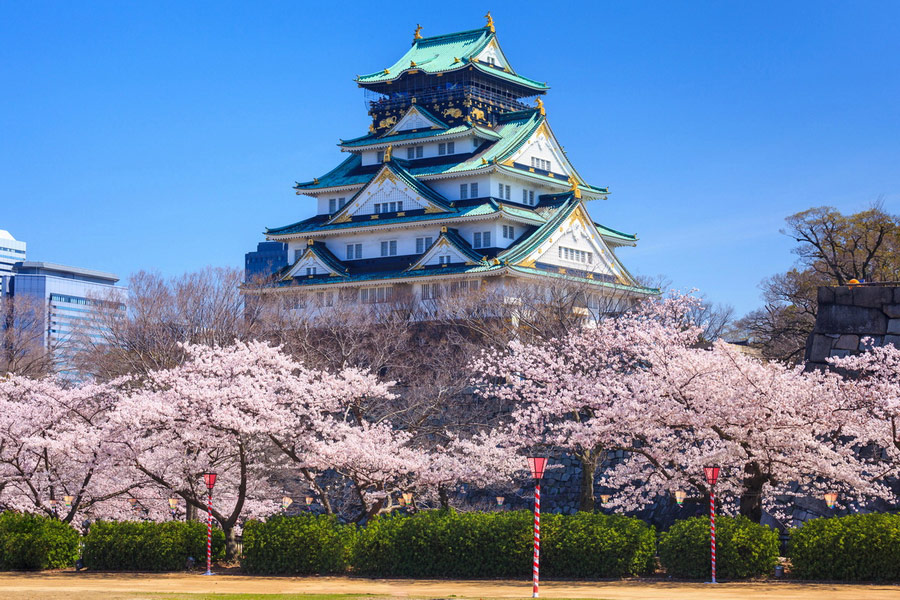
Osaka Castle is a symbol of Japan’s rich history, offering panoramic views from its observation deck. Originally built by Toyotomi Hideyoshi in 1583 — the warlord who came closer than anyone to unifying Japan before Tokugawa — the castle was burned, rebuilt, destroyed again, and resurrected multiple times, which makes it either a testament to persistence or a monument to the stubbornness of history, depending on your perspective. The castle tower stands surrounded by the largest dry moat in Japan. In spring, the surrounding park erupts in cherry blossoms. In autumn, maple and ginkgo trees set the grounds on fire with color. Fashionista
Shinsekai — The Neighborhood That Time Chose Differently
Shinsekai is grittier and more authentic than the tourist-heavy Dotonbori — come here for the real Osaka food experience. Built in the early 20th century as a utopian entertainment district modeled on Paris and New York, Shinsekai fell into decline after the war and stayed there, magnificently and stubbornly, while the rest of the city modernized. The result is one of the most atmospheric neighborhoods in Japan — retro pachinko parlors, veteran kushikatsu restaurants, the Tsutenkaku Tower glowing orange above it all, and elderly locals playing shogi at folding tables on the street. Come for dinner. Stay for the feeling that you have stepped forty years back in time. Daily Front Row
Kuromon Ichiba Market — Osaka’s Kitchen, Open to Everyone
Kuromon Ichiba Market has over 190 years of history and a very simple mission: make you hungry every ten steps. It’s often called “Osaka’s Kitchen,” and it’s where locals shop for ingredients while visitors roam around sampling freshly prepared snacks like it’s a sport. Who What Wear
The shopping street stretching about 600 meters is lined with over 100 shops. Fresh seafood, colorful vegetables and fruits, and Osaka specialties like takoyaki and okonomiyaki — everything stimulates all five senses. What’s particularly impressive is the energetic calls and smiles of the shop owners. Just listening to the witty Kansai-style exchanges naturally brings a smile to your face. Go before 11am for the freshest produce and the best atmosphere. Coveteur
Umeda — The Modern Osaka That Never Sleeps
Umeda is Osaka’s other face — gleaming department stores, underground shopping labyrinths, the architectural drama of the Umeda Sky Building. The “Umeda Dungeon” is the affectionate nickname for the vast, labyrinthine network of underground shopping malls connecting JR Osaka Station, Umeda Station, and several department stores. It’s a city beneath the city — a sprawling maze of shops, restaurants, and cafes that Osakans navigate with the casual ease of people who have memorized a living organism. For visitors, getting lost here is not a failure. It is the point. Center for American Progress
The Umeda Sky Building Observatory offers some of the best views in Osaka — particularly spectacular at night, when the city’s lights spread in every direction like a circuit board switched on at full power. aol
Sumiyoshi Taisha — The Shrine That Predates Buddhism in Japan
Away from the noise, Sumiyoshi Taisha is one of Japan’s oldest Shinto shrines — predating the introduction of Buddhism, which means its architectural style is purely Japanese, without any Chinese or Korean influence. The iconic arched bridge over the central pond, the ancient cedar trees, the processional corridors of stone lanterns — this is one of those places that earns complete silence from even the loudest visitors.
🍽️ What to Eat: A Serious Guide to Osaka’s Serious Business
Eating in Osaka is not a casual activity. It is a commitment, a culture, and by local standards, a moral obligation.
Takoyaki — The Dish That Defines a City
Takoyaki is made by wrapping octopus in wheat flour mixed with dashi broth and cooking it in plenty of oil. It’s said that almost every household in Osaka owns a takoyaki maker. Crispy on the outside, molten on the inside, topped with sauce, mayonnaise, bonito flakes, and green onions — the best stalls have a visible griddle where you can watch the cook deftly turn each ball. A serving of eight costs around ¥600. You will order another one before you finish the first. aolDaily Front Row
Okonomiyaki — The Savory Pancake That Hugs You Back
Okonomiyaki is a savory pancake built from a batter of flour and eggs, mixed with shredded cabbage, and loaded with toppings like pork belly, shrimp, or cheese. It’s grilled flat, then finished with okonomiyaki sauce, mayonnaise, seaweed powder, and bonito flakes — because Osaka doesn’t do subtle. Some spots let you cook it yourself at the table. Mizuno on Dotonbori is the classic destination. Fukutaro nearby is the local’s alternative. Both are worth the queue. Who What Wear
Kushikatsu — The Art of the Perfect Skewer
Shinsekai’s great gift to the world is kushikatsu — various ingredients crumbed, skewered, and deep-fried to a golden finish, then dipped in a communal sauce. The rule is sacred and non-negotiable: no double dipping. You dip your skewer once. You do not dip it again. If you need more sauce, use the provided cabbage leaf as a scoop. Violating this rule in a Shinsekai restaurant is the kind of thing that changes the atmosphere of an entire room.
551 Horai Butaman — The Pork Bun That Has Its Own Fan Club
551 Horai’s steaming red boxes are an Osaka institution — and if you see someone on a Shinkansen carrying one, you will know immediately they have been in Osaka. The pork buns are plump, juicy, slightly sweet, and completely addictive. The queues at the Namba flagship are long and entirely worth it. Buy six. Eat four on the spot. Try not to eat the remaining two on the train. Daily Front Row
The Kissaten Breakfast — The Meal Osaka Does Quietly
Breakfast in Osaka is kissaten culture — locals grab thick toast, hard-boiled eggs, and coffee at neighborhood coffee shops that have barely changed since the 1970s. These small, smoky, utterly unpretentious cafes are among the most comforting spaces in Japan. Find one near your hotel, order the morning set, and watch the city wake up through the window. Refinery29
🌙 Nights in Osaka: The City That Doesn’t Check the Time
Osaka boasts a vibrant nightlife with many attractions staying open until late at night — teamLab garden Osaka, Spa World, the Ebisu Tower Ferris Wheel, and the Umeda Sky Building Observatory among them. aol
But Osaka’s best nightlife is not the attractions. It is the izakayas — Japan’s answer to the tavern, where cold draft beer, small plates of grilled things, and rambling conversation stretch effortlessly from 7pm to midnight. Find a narrow one in an alley behind Shinsaibashi, slide open the wooden door, squeeze onto a stool at the counter, point at what the person next to you is eating, and order two of it. No reservation required. No dress code observed. The evening will take care of itself.
🗺️ Practical Notes: Getting the Most from Osaka
Osaka costs 15–25% less than Tokyo for accommodation, dining, and local experiences. The Osaka Amazing Pass — ¥3,500 for one day, ¥5,000 for two — covers unlimited metro, bus, and private railway access plus entry to 40+ attractions. It is extraordinary value and removes the mental overhead of fare calculation entirely. WWD
Osaka Metro and the JR Loop Line provide the most efficient city transportation, with single rides costing ¥180–400. The compact central districts of Umeda, Namba, and Tennoji are highly walkable, with 15–25 minute walks connecting major neighborhoods. WWD
Osaka and Kyoto together is the classic combination for a reason. They are 15 minutes apart by Shinkansen, 30 minutes by regular express. The two cities are each other’s perfect foil — one holds the past in silence; the other holds the present in noise. Together, they hold almost everything Japan has to give.
The Real Reason to Go
Osaka will feed you beyond capacity, make you laugh when you weren’t planning to, invite you into conversations you don’t have the language for, and send you home slightly stunned by how much warmth a city of 2.7 million people can generate.
Osakans will tell you theirs is a more real, honest, friendly, and earthy place — with a deeper history and a richer sense of humor than anywhere else in Japan. Many say it is the heart of Japan. Oxford Economics
They are not wrong. Arrive hungry. Leave full of everything.
Travel tips and prices are current as of May 2026. Always check individual venue and attraction information before visiting, as hours, prices, and availability change regularly.
[…] Want the full picture of each city on its own terms? Read our standalone portraits: Tokyo — A City That Contains Multitudes and Osaka: Japan’s Loudest, Hungriest, Most Lovable City. […]
To provide the best experiences, we use technologies like cookies to store and/or access device information. Consenting to these technologies will allow us to process data such as browsing behavior or unique IDs on this site. Not consenting or withdrawing consent, may adversely affect certain features and functions.
Functional
Always active
The technical storage or access is strictly necessary for the legitimate purpose of enabling the use of a specific service explicitly requested by the subscriber or user, or for the sole purpose of carrying out the transmission of a communication over an electronic communications network.
Preferences
The technical storage or access is necessary for the legitimate purpose of storing preferences that are not requested by the subscriber or user.
Statistics
The technical storage or access that is used exclusively for statistical purposes.The technical storage or access that is used exclusively for anonymous statistical purposes. Without a subpoena, voluntary compliance on the part of your Internet Service Provider, or additional records from a third party, information stored or retrieved for this purpose alone cannot usually be used to identify you.
Marketing
The technical storage or access is required to create user profiles to send advertising, or to track the user on a website or across several websites for similar marketing purposes.


Leave a Reply