Seoul vs Tokyo: Which Asian Megacity Should You Visit?
Billy Park
·
CITY PORTRAIT — NO. 02
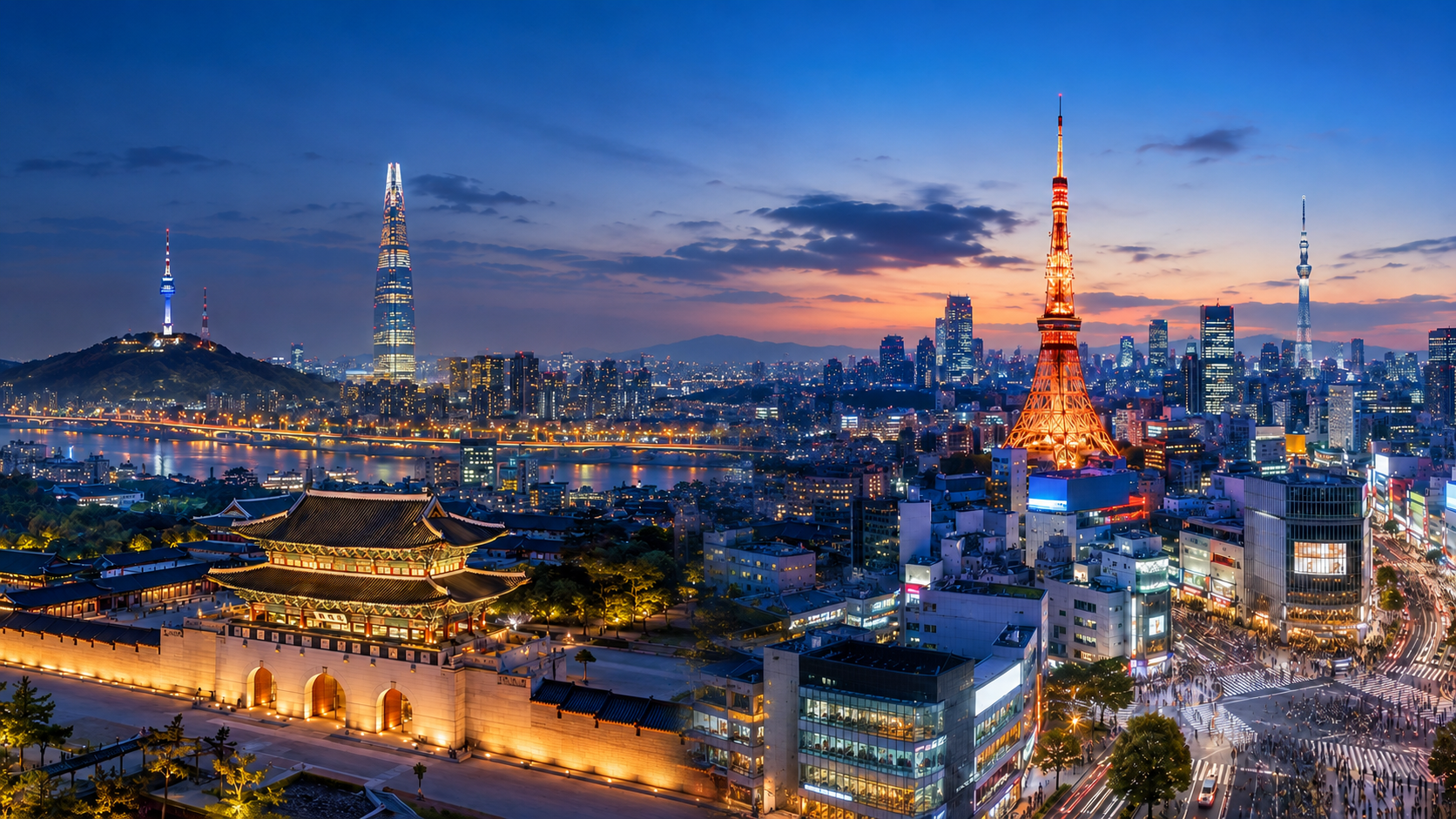
서울 vs 東京 Seoul & Tokyo
Two cities. Two thousand kilometres apart. One rivalry that defines modern Asia.
SOUTH KOREA · JAPAN · EAST ASIA
SEOUL
9.6M
CITY POPULATION
26M
METRO POPULATION
$991B
METRO GDP
TOKYO
14M
CITY POPULATION
38M
METRO POPULATION
$1.77T
METRO GDP
Seoul moves like it has something to prove. Tokyo moves like it already has. Together they represent the two great competing visions of what an Asian megacity can be — and choosing between them says more about you than it does about either city.
Both cities sit within a two-hour flight of each other. Both are hyper-connected, safe, food-obsessed, and unmistakably modern. But spend a week in each and the differences become stark — in pace, in aesthetics, in how each city relates to its own past and its own people. This is a comparison of two cities that admire, envy, and quietly define themselves against each other.
01 —
Energy & Pace
SEOUL
Seoul is kinetic. It’s a city that rebuilt itself from rubble within living memory and has never quite stopped accelerating. The Han River miracle — South Korea’s transformation from one of the world’s poorest countries to a top-15 economy in a single generation — is written into Seoul’s bones. Construction cranes are permanent fixtures on the skyline. Neighbourhoods that were artist enclaves five years ago are now luxury developments. The city doesn’t sit still long enough to feel nostalgic.
TOKYO
Tokyo moves with a different kind of urgency — precise, choreographed, unhurried in its certainty. Rush hour on the Yamanote Line is a masterpiece of managed density. But Tokyo doesn’t hustle; it executes. There’s a settled confidence to the city that comes from centuries of being the centre of things. Change happens in Tokyo too — but it happens deliberately, with one eye always on what came before.
“Seoul feels like a city mid-sentence. Tokyo feels like a city that has already made its point.”
02 —
Culture & Identity
SEOUL
Seoul’s cultural identity is loud, global, and unapologetically ambitious. K-pop, K-drama, K-beauty, K-food — the Korean Wave (hallyu) is the most successful cultural export project of the 21st century, and Seoul is its factory floor and its showroom. The city is acutely aware of its global image and works hard to shape it. Hongdae pulses with live music. Itaewon (now re-emerging after tragedy) was Asia’s most international neighbourhood. Culture here is a product, and Seoul is very good at making products the world wants.
TOKYO
Tokyo’s cultural identity is deep, layered, and largely indifferent to whether you understand it. Anime, manga, and video games have conquered the world — but Tokyo didn’t set out to export them; it was simply doing what it does. The city’s subcultures — from Harajuku fashion tribes to jazz kissa devotees to the obsessive hobbyist communities of Akihabara — exist primarily for themselves. Tokyo culture is intrinsic rather than performed. That interiority is precisely what makes it so compelling to outsiders.
03 —
Food
This is the category where the debate gets most heated — and most personal. Both cities have legitimate claims to being among the world’s great food destinations. They are not, however, the same kind of great.
SEOUL
Seoul’s food is bold, communal, and built for sharing. Korean BBQ — samgyeopsal sizzling on a table grill, scissors cutting through pork belly, soju glasses refilled before they’re empty — is one of the world’s great eating experiences not just because of the food but because of the ritual. Banchan, the constellation of small dishes that accompany every meal, means you never eat alone even when you are. Street food in Gwangjang Market — bindaetteok, mayak kimbap, raw beef yukhoe — is serious, cheap, and extraordinary. Seoul eats loudly and with conviction.
TOKYO
Tokyo’s food is precise, individual, and devoted to craft above all else. With more Michelin stars than any other city on Earth, it has the credentials — but the real story is the depth at every price point. A ¥800 bowl of ramen at a counter stool can be a genuinely transcendent experience. The shokunin ethic — the master craftsperson dedicating decades to a single discipline — produces sushi chefs, soba makers, and tempura cooks whose work borders on meditation. Tokyo eats quietly, with reverence, and the food rewards that attention.
“In Seoul you eat with the table. In Tokyo you eat with the chef.”
04 —
Nightlife & Social Life
SEOUL
Seoul is one of the world’s great nightlife cities — open, loud, and genuinely 24-hour. The subway runs through the night on weekends. Pojangmacha street stalls do their best business after midnight. Gangnam’s clubs draw international DJs. Hongdae’s indie bars and live venues stay packed until dawn. Koreans drink enthusiastically and socially — the concept of hoesik (work dinners) and multi-round nights that move from restaurant to bar to norebang (karaoke) means that an evening out is rarely just one thing.
TOKYO
Tokyo’s nightlife is excellent but more distributed and more discreet. Shinjuku’s Golden Gai — over 200 tiny bars crammed into six narrow alleys — is one of the world’s great drinking experiences. Shibuya and Roppongi cater to bigger nights out. But the more characteristically Tokyo experience is the izakaya: long, intimate evenings of small plates and sake where conversation is the point. The last train home at midnight shapes the night differently than Seoul’s all-night subway — Tokyo evenings tend to end rather than continue.
05 —
For Visitors
SEOUL
Seoul is arguably the easier city to visit as a first-time traveller to Asia. English signage is widespread, locals are generally outgoing and willing to help, and the T-money card handles all transit effortlessly. It’s also excellent value — accommodation, food, and transport all compare favourably to Tokyo. The city rewards exploration: neighbourhoods like Bukchon Hanok Village, Insadong, Seongsu (Seoul’s Brooklyn), and the palace district each offer something distinct. K-culture tourism — visiting drama filming locations, attending idol fan meetings, exploring the beauty districts of Myeongdong — has created an entirely new category of travel.
TOKYO
Tokyo rewards patience and return visits. The city is comprehensible on a first trip but reveals itself slowly — the neighbourhood you walked through on day two looks completely different when you understand it on day ten. The yen’s recent weakness has made Tokyo extraordinary value for international visitors. Infrastructure is flawless: the IC card system, Google Maps integration with train networks, and increasingly bilingual signage make navigation intuitive. The depth of experience on offer — from world-class museums to hidden izakayas to century-old craft workshops — means Tokyo is rarely exhausted, no matter how many times you return.
06 —
The Verdict
The honest answer is that Seoul and Tokyo are not really competing for the same thing. They are profoundly different cities that happen to share a geography and a mutual fascination with each other.
If you want…
Go to…
Raw, electric energy and a city on the rise
Seoul
Depth, craft, and quiet perfection
Tokyo
The world’s best nightlife
Seoul
The world’s best food at every price point
Tokyo
Global pop culture at its source
Seoul
Subcultures that exist for their own sake
Tokyo
A city that feels like the future
Both
A city that feels like it has always existed
Tokyo
Value for money
Seoul (slightly)
Infrastructure perfection
Tokyo (just)
Go to Seoul if you want to feel the pulse of a city still becoming itself. Go to Tokyo if you want to understand what a city looks like when it has fully arrived. Go to both if you can — and you should, because together they make the strongest possible case that the 21st century belongs to Asia.
The real answer isn’t Seoul or Tokyo. It’s Seoul then Tokyo — or Tokyo then Seoul. Do both. The comparison only makes sense in person.
Figures: Seoul city population 9,579,449 as of Q1 2026 (Seoul Metropolitan Government); Seoul Capital Area metro population 26.0 million with metro GDP of US$991 billion (nominal, 2024); Greater Tokyo urban population 38.1 million with metro GDP of US$1.766 trillion (nominal, 2022). Sources below. GDP years differ by source and are not directly comparable.
[…] Trying to decide between cities? See how Tokyo stacks up in Tokyo vs Osaka: Japan’s Greatest Internal Argument, Tokyo vs Hong Kong, and Seoul vs Tokyo. […]
To provide the best experiences, we use technologies like cookies to store and/or access device information. Consenting to these technologies will allow us to process data such as browsing behavior or unique IDs on this site. Not consenting or withdrawing consent, may adversely affect certain features and functions.
Functional
Always active
The technical storage or access is strictly necessary for the legitimate purpose of enabling the use of a specific service explicitly requested by the subscriber or user, or for the sole purpose of carrying out the transmission of a communication over an electronic communications network.
Preferences
The technical storage or access is necessary for the legitimate purpose of storing preferences that are not requested by the subscriber or user.
Statistics
The technical storage or access that is used exclusively for statistical purposes.The technical storage or access that is used exclusively for anonymous statistical purposes. Without a subpoena, voluntary compliance on the part of your Internet Service Provider, or additional records from a third party, information stored or retrieved for this purpose alone cannot usually be used to identify you.
Marketing
The technical storage or access is required to create user profiles to send advertising, or to track the user on a website or across several websites for similar marketing purposes.


Leave a Reply