Tokyo vs Hong Kong: Two Skylines, Two Very Different Second Acts
Billy Park
·
CITY PORTRAIT — NO. 04
東京 vs 香港 Tokyo & Hong Kong
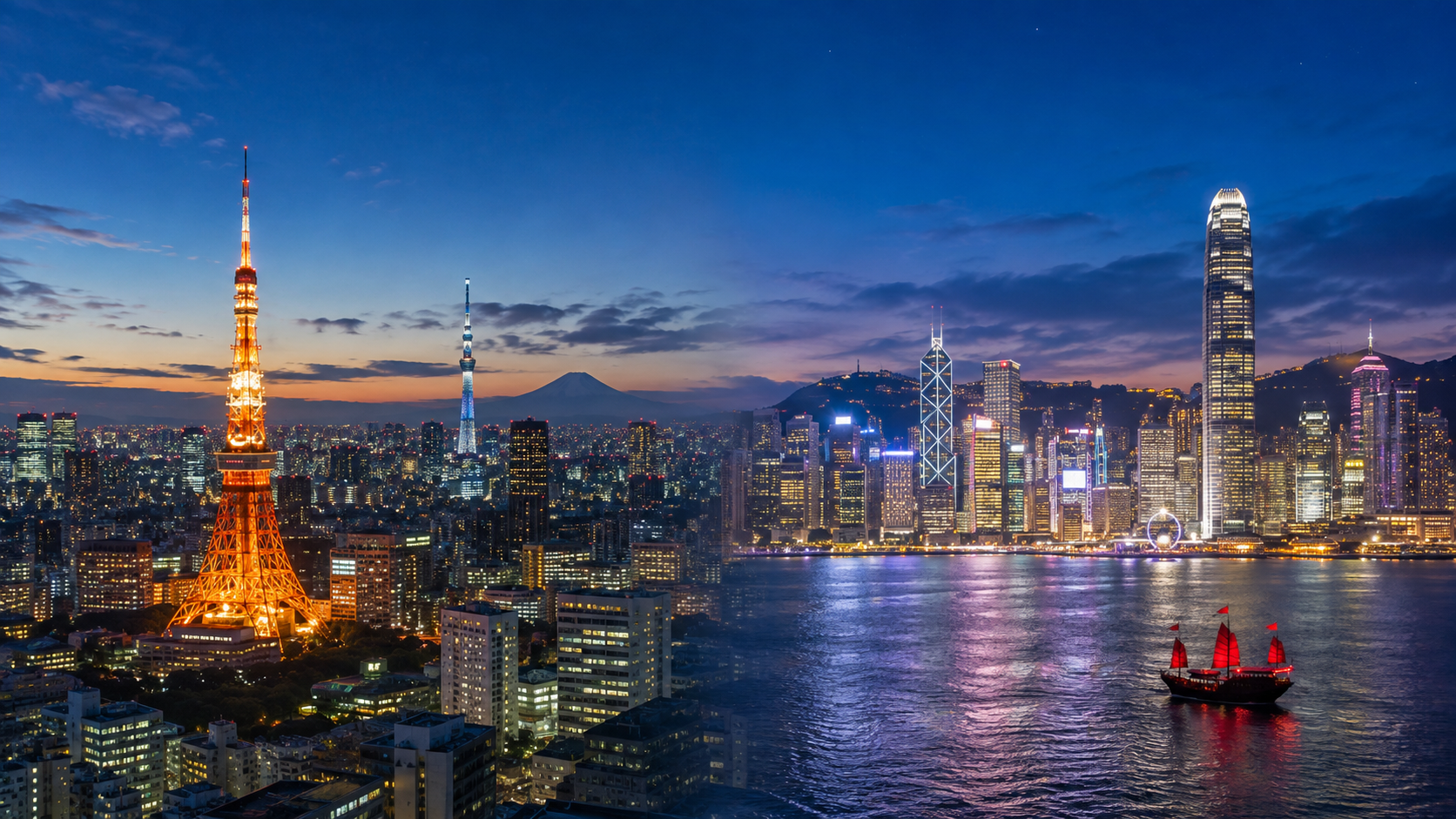
Two skylines that defined a century. Two cities writing very different second acts.
KANTO REGION, JAPAN · SPECIAL ADMINISTRATIVE REGION, CHINA
TOKYO
38M
METRO POPULATION
$1.77T
METRO GDP
2,194
SQ KM (CITY)
HONG KONG
7.5M
POPULATION
$425B
GDP
1,114
SQ KM (TERRITORY)
For decades, Tokyo and Hong Kong were Asia’s twin poles of ambition — the two cities every global business, every serious traveller, and every restless dreamer had to reckon with. They still are extraordinary. But they are no longer the same cities they were. And that difference is the most interesting thing about them.
Tokyo is a city of extraordinary continuity — it changes constantly but always on its own terms, always from within. Hong Kong is a city mid-transformation, its identity under negotiation in ways that would have been unthinkable a decade ago. To compare them now is to compare not just two cities but two very different relationships with time, with identity, and with the question of what a great city actually owes its people.
01 —
Energy & Character
TOKYO
Tokyo’s energy is deep and self-contained. It is a city that has been the centre of things for so long that it no longer needs to announce itself. There is a settled, almost gravitational quality to Tokyo — it pulls everything toward it without visibly straining. The pace is fast but unhurried, purposeful but never frantic. The city operates with the confidence of a place that knows exactly what it is: the world’s greatest urban machine, running on civic pride, collective discipline, and an almost spiritual commitment to doing things well.
HONG KONG
Hong Kong’s energy has always been different — more exposed, more electric, more anxious. Built on a vertical island with no natural resources and no hinterland, the city’s entire existence has been a wager on human ingenuity and commercial instinct. The result was one of the most thrillingly alive cities on Earth: a place where East and West collided daily, where fortunes were made in a generation, where the harbour view from the Peak at night felt like looking at the future. That energy still exists. But it sits alongside a new uncertainty that didn’t used to be there.
“Tokyo knows what it is. Hong Kong is in the middle of finding out.”
02 —
Food
Both cities have extraordinary food cultures. Both sit near the very top of any honest global ranking. But they arrive at greatness from completely different directions.
TOKYO
Tokyo’s food greatness is rooted in the shokunin ethic — the master craftsperson who devotes decades to a single discipline. It is a city of specialists: the ramen chef who has spent 30 years perfecting a tonkotsu broth, the sushi master who selects his fish personally at 4am, the tempura cook who has memorised the precise oil temperature for each ingredient. The depth extends down to every price point — a ¥600 standing soba lunch can be a genuine revelation. Tokyo has more Michelin stars than any city on Earth, but the city’s true achievement is the extraordinary quality hidden in plain sight at every level.
HONG KONG
Hong Kong’s food greatness is rooted in collision — Cantonese tradition meeting British influence meeting the cuisines of every corner of China and Southeast Asia that washed through this port city over 150 years. The result is one of the world’s most exciting food cities. Dim sum here is the benchmark — pushed carts at 7am, har gow and siu mai and cheung fun, the whole magnificent ritual of yum cha. The cha chaan teng — Hong Kong’s hybrid café serving milk tea, pineapple buns, and scrambled eggs on toast — is one of the world’s great culinary inventions and entirely specific to this city. Roast goose in Sham Shui Po. Wonton noodles in a Kowloon back street. The food here is exceptional, deeply personal, and irreplaceable.
“Tokyo perfected one cuisine. Hong Kong invented its own.”
03 —
Skyline & Geography
TOKYO
Tokyo sprawls. It is a horizontal city of extraordinary scale — a vast, low-density federation of neighbourhoods spreading across the Kanto Plain in every direction, punctuated by clusters of towers in Shinjuku, Shibuya, and Marunouchi. Its geography is flat and navigable, its sheer size occasionally overwhelming. But the scale brings its own reward: Tokyo contains more distinct worlds within it than almost any city on Earth. It is a place you can get genuinely lost in — and want to.
HONG KONG
Hong Kong compresses. Hemmed in by Victoria Harbour on one side and steep green peaks on the other, the city had no choice but to build upward — and the result is one of the world’s most dramatic urban landscapes. The view of the harbour from the Peak at night, with towers blazing on both Kowloon and Hong Kong Island, is among the most iconic cityscapes on Earth. The geography creates constant drama: you can be in the middle of one of the world’s densest urban environments and within 20 minutes be hiking an empty coastal trail with nothing but ocean in front of you. The contrast is extraordinary and uniquely Hong Kong.
04 —
Culture & Identity
TOKYO
Tokyo’s cultural identity is ancient, layered, and entirely self-referential. It does not borrow; it absorbs and transforms. Western influences — jazz, denim, French pastry, Italian coffee — have all been taken in and made unmistakably Japanese. The city’s subcultures are genuine and self-sustaining: they exist for their own participants first, and for outside observers a distant second. There is a depth and continuity to Tokyo’s cultural life that comes from centuries of being the seat of power, the centre of aesthetics, the place where Japan decides what Japan is.
HONG KONG
Hong Kong’s cultural identity was built on hybridity — the thing that made it unique was the productive tension between Chinese and British influences, between ancient Cantonese culture and colonial modernity, between the village and the trading floor. Cantopop, Hong Kong cinema’s golden era, the city’s distinctive visual language, its irreverent humour — all of it emerged from that collision. That identity is now navigating a period of significant change. What is certain is that Hong Kong’s cultural DNA — its Cantonese roots, its appetite for commerce, its specific, stubborn sense of humour — runs too deep to be easily rewritten.
05 —
For Visitors
TOKYO
Tokyo is one of the world’s safest, easiest, and most rewarding cities to visit. The infrastructure is flawless, English signage is improving rapidly, and the IC card system makes transit effortless. The weak yen has made it exceptional value. The challenge is its sheer scale — a first visit can feel overwhelming — but this is best solved by slowing down, picking two or three neighbourhoods per day, and allowing the city to reveal itself. Tokyo repays every return visit with new layers. Most serious travellers find themselves coming back every year and still finding new things.
HONG KONG
Hong Kong remains a superb destination — compact, bilingual, spectacular, and still one of the world’s great food cities. The MTR is among the best metro systems on Earth. The Star Ferry across the harbour costs almost nothing and is one of the world’s great commutes. Day trips to outlying islands like Cheung Chau and Lantau offer a completely different face of the territory. Visitors will find the city functioning well and the hospitality industry at its professional best. What has changed is less visible to the short-term visitor — it is felt in conversations, in the city’s relationship with its own recent past, in the quieter cultural venues and the changed media landscape.
06 —
The Verdict
Tokyo and Hong Kong have defined Asia for the world’s imagination for half a century. They remain two of the most extraordinary cities on Earth. But their trajectories have diverged — and understanding that divergence is part of understanding both of them.
If you want…
Go to…
World’s best food depth at every price
Tokyo
World’s best dim sum and Cantonese food
Hong Kong
The most dramatic urban skyline
Hong Kong
The world’s greatest urban sprawl to explore
Tokyo
A city that feels entirely settled in itself
Tokyo
East-West cultural collision in one place
Hong Kong
Hiking and nature inside a megacity
Hong Kong
Depth of subculture and craft
Tokyo
Value for money right now
Tokyo
The most compact, navigable first visit
Hong Kong
If you have never been to Asia and can only choose one: Tokyo. It is the more complete city, the deeper experience, and right now extraordinary value. But Hong Kong is not a consolation prize — it is one of the world’s great cities, unique in ways that no other place on Earth replicates, and it deserves to be visited on its own terms rather than measured against what it used to be.
The best version of this trip, as always, is both. They are three hours apart by air. Hong Kong’s vertical drama and Cantonese soul, then Tokyo’s horizontal depth and quiet perfection — or the reverse. Together they make the strongest possible case that the great cities of the world are still being written, and Asia is holding the pen.
Hong Kong taught the world what ambition looks like. Tokyo taught it what perfection looks like. The world is still learning from both.
Figures: Greater Tokyo urban population 38.1 million with metro GDP of US$1.766 trillion (nominal, 2022); Hong Kong population approximately 7.50 million in mid-2025, land area 1,114.57 sq km, GDP HK$3,329.8 billion in 2025 (about US$425 billion at the pegged rate). Sources below. GDP years differ by source and are not directly comparable.
To provide the best experiences, we use technologies like cookies to store and/or access device information. Consenting to these technologies will allow us to process data such as browsing behavior or unique IDs on this site. Not consenting or withdrawing consent, may adversely affect certain features and functions.
Functional
Always active
The technical storage or access is strictly necessary for the legitimate purpose of enabling the use of a specific service explicitly requested by the subscriber or user, or for the sole purpose of carrying out the transmission of a communication over an electronic communications network.
Preferences
The technical storage or access is necessary for the legitimate purpose of storing preferences that are not requested by the subscriber or user.
Statistics
The technical storage or access that is used exclusively for statistical purposes.The technical storage or access that is used exclusively for anonymous statistical purposes. Without a subpoena, voluntary compliance on the part of your Internet Service Provider, or additional records from a third party, information stored or retrieved for this purpose alone cannot usually be used to identify you.
Marketing
The technical storage or access is required to create user profiles to send advertising, or to track the user on a website or across several websites for similar marketing purposes.


Leave a Reply