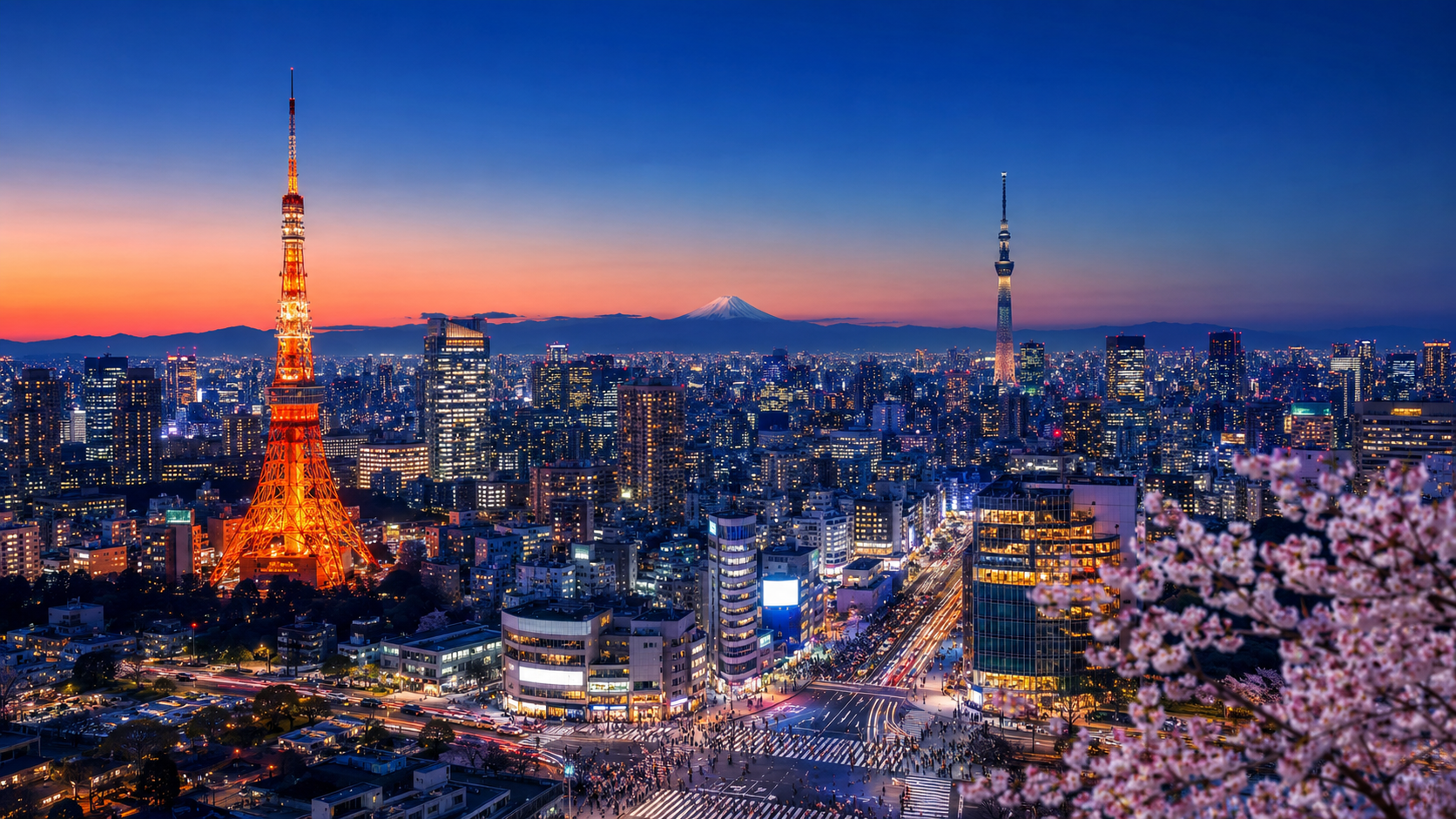
CITY PORTRAIT — NO. 01
東京
Tokyo
Where ancient ritual and electric future share the same street — and somehow neither blinks first.
37 MILLION SOULS · 139.69°E · KANTO REGION, JAPAN
Tokyo does not explain itself. It simply is — a city so fully alive that first-time visitors often stand in the middle of Shibuya Crossing and forget, momentarily, where they came from.
The largest metropolitan area on Earth is also, paradoxically, one of the most orderly. Trains run to the second. Convenience stores are temples of curation. The food is, by any honest measure, the best in the world. And beneath all of it — the neon, the temples, the salary-worker suits and the Harajuku peacocks — runs a deep cultural current that has been bending and reforming itself for centuries without ever quite breaking.
01 —
Culture & Soul
Tokyo’s culture is built on a tension so productive it has become its greatest creative engine: the coexistence of mono no aware — the bittersweet awareness of impermanence — and an almost obsessive commitment to mastery and perfection. You see it everywhere. A soba chef who has spent 40 years perfecting a single broth. Cherry blossoms celebrated precisely because they fall so fast. A city that rebuilds itself every generation without losing its essential character.
The concept of omotenashi — selfless hospitality — is not a marketing slogan here. It is the operational logic of the entire city. When a department store escalator is reversed at midday to accommodate the afternoon shopping crowd, that is omotenashi. When a taxi driver wears white gloves and your receipt is handed to you with both hands, that is omotenashi. The guest’s comfort is considered before the guest thinks to ask.
“Tokyo is a city that will make you feel both completely anonymous and absolutely seen — sometimes within the same hour.”
Three cultural codes shape daily life: honne (true feelings, kept private) versus tatemae (public face, kept smooth); the reverence for shokunin — the craftsperson who achieves mastery through dedication rather than genius; and the uniquely Japanese capacity to hold tradition and avant-garde not as opposites but as complements, evident in everything from architecture to cuisine to fashion.
02 —
The Neighbourhoods
Tokyo is not one city but thirty — a federation of distinct neighbourhoods, each with its own velocity and mood. The mistake is to spend too long in any single one.
OLD TOKYO
Asakusa & Yanaka
Senso-ji in the blue hour before crowds arrive. Narrow shotengai shopping streets. Yanaka cemetery in autumn. This is Edo’s ghost, still breathing.
SUBCULTURE
Akihabara & Harajuku
Manga, electronics, seven-story arcades. Harajuku’s Ura-Harajuku backstreets — where genuine street fashion has survived despite the tourists.
DESIGN & GALLERIES
Daikanyama & Nakameguro
The Tsutaya Books complex. The canal walk at dusk. The best independent coffee in the city. This is where Tokyo gets quietly cool.
COMMERCE & CHAOS
Shinjuku & Shibuya
The crossing that has become a secular pilgrimage. Kabukicho’s neon warren. Memory Lane — Omoide Yokocho — for yakitori and sake under the train tracks.
PARKS & PALACES
Ueno & Marunouchi
The Imperial Palace gardens. World-class museums clustered around Ueno Park. Cherry blossom season here is a genuine spectacle of collective joy.
WATERFRONT NEW
Odaiba & Toyosu
The reclaimed bay area — futuristic shopping, teamLab’s digital art installations, and the world’s finest fish market relocated and reimagined.
03 —
The Food
Tokyo holds more MICHELIN-starred restaurants than any other city on Earth. But the city’s true food culture isn’t in the starred restaurants. It’s in the standing ramen counter at 2am, the 300-yen onigiri at 7-Eleven assembled fresh that morning, the sushi chef’s counter where eight seats watch a lifetime of training compressed into a meal.
- Sushi & Omakase — From Tsukiji outer market tuna on rice for ¥500 to a 20-course omakase in Ginza where the chef composes each piece to the season and the guest. Both are serious. Both are worth your time.
- Ramen — Each regional style a distinct philosophical position: Sapporo’s miso richness, Hakata’s tonkotsu opacity, Tokyo’s shoyu clarity. The best bowls are in basement stalls, earned by the queue you waited in.
- Izakaya culture — Not a restaurant, not a bar — an institution. The izakaya is where Tokyo’s social fabric loosens over small plates of karaage, edamame, tamagoyaki, and endless tokkuri of cold sake.
- Tempura, Soba & Tonkatsu — Tempura fried in pure sesame oil — the shrimp still translucent at the centre. Handmade soba that smells of buckwheat fields. Tonkatsu breaded and fried until the crust shatters. Mastery hiding in plain sight.
- Convenience & Street — Japan’s konbini culture is a culinary achievement in miniature: freshly stocked onigiri, hot oden in winter, seasonal matcha pastries. The 7-Eleven egg salad sandwich has become a genuine tourist pilgrimage.
04 —
The People
Tokyo works — the subways, the streets, the social contract — because of a collective agreement to keep it working. The city has internalised a remarkable civic discipline without requiring enforcement. Rubbish bins are scarce; litter is almost nonexistent. Rush hour packs more humans into train carriages than physics seems to allow; yet no one raises a voice.
This is sometimes read by Western visitors as coldness. It is the opposite. It is a profound respect for the shared space — a refusal to impose one’s inconvenience on another. Ask for directions and a stranger may walk you to your destination. Drop a wallet and it will be turned in, contents untouched, within the hour.
Tokyo is simultaneously one of the world’s loneliest cities — single-person households exceed 50% in some wards — and one of its most convivial. The izakaya, the sento bathhouse, the neighbourhood cherry blossom picnic, the company after-work nomikai: collective rituals that keep the social tissue from tearing. The city has invented spectacular systems of being alone together.
“You can live in Tokyo for years and never be invited to a Japanese person’s home — and never want for warmth.”
Japanese society is changing. Record numbers of foreign residents (now over 600,000 in the city alone), rising divorce rates, declining marriage rates, a youth generation more comfortable expressing individuality than their parents — Tokyo is quietly negotiating a new identity while holding its old one in careful hands.
05 —
Visitors & Tourism
For much of the 2010s, Tokyo was a well-kept secret among serious travellers — safe, inexpensive, extraordinary, and curiously underrated compared to Paris or New York. That changed decisively. Post-pandemic Japan has seen surging visitor numbers, driven by a weakened yen, global appetite for Japanese culture amplified by food media and anime, and word-of-mouth consensus that Tokyo may simply be the best city in the world to visit.
South Korean, Chinese, Taiwanese, and Southeast Asian visitors dominate by volume. Western visitors — particularly from the US, UK, and France — have grown significantly. The traveller profile has diversified from culture tourists to food pilgrims, anime fans, fashion scouts, and a growing class of digital nomads drawn to Tokyo’s safety, infrastructure, and quality of life.
The city’s visitor infrastructure is world-class and getting better. The IC card system (Suica or Pasmo) handles all transit seamlessly. Google Maps works flawlessly for trains. Most major signs and menus now include English. And yet the city has not bent to tourism — unlike many other global destinations, Tokyo’s neighbourhoods, restaurants, and cultural spaces remain primarily for their own residents.
Tensions are emerging. Overtourism in Kyoto has Tokyo watching carefully. Some areas — Senso-ji, Shibuya Crossing, teamLab venues — have become congested to the point of impeding the experience they offer. The city is experimenting with crowd management, dispersal tourism to less-visited wards, and pricing mechanisms. How Tokyo manages the next decade of growth will be a case study for global cities.
06 —
The Economy
Tokyo’s metropolitan economy is among the largest in the world — rivalling the GDP of entire nations. It is home to the Tokyo Stock Exchange (one of the world’s top three by market capitalisation), the regional or global headquarters of most of Japan’s largest corporations, and a financial and professional services sector that underpins Asia-Pacific commerce.
| Metro GDP (est.) | ~$1.77 trillion USD |
| Fortune Global 500 HQs | 51 companies |
| TSE Market Cap | ~$6 trillion USD |
| Tourism Revenue (2023) | ¥5.8 trillion |
| Tech startup ecosystem rank | Top 15 globally |
| Unemployment rate | ~2.5% |
The economy is undergoing genuine structural change after decades of stagnation. The Bank of Japan’s historic pivot away from negative interest rates in 2024, rising corporate governance standards pushed by activist investors and the TSE itself, and a renewed interest from foreign capital are reshaping Japanese business culture from within. Startups — long a cultural outlier in a corporate-ladder society — are gaining legitimacy, particularly in deep tech, robotics, and materials science where Japan holds durable advantages.
Tourism has become an increasingly significant economic pillar. The weak yen transformed Japan from expensive-but-worth-it to extraordinary value, producing a visitor boom that is stress-testing infrastructure while generating substantial revenue. The government has ambitious targets for inbound tourism as a long-term economic lever — with Tokyo as its primary engine.
The shadow over all of this is demography. Japan’s population decline is the fastest in the developed world, and Tokyo — despite being a magnet for domestic migration — cannot escape it. The city is beginning to grapple with managed contraction in some areas even as other districts surge. How it navigates that contradiction may define the city’s character in the second half of this century.
Come for the food. Stay for the discipline. Leave changed, somehow, by a city that asked nothing of you except that you pay attention.
Trying to decide between cities? See how Tokyo stacks up in Tokyo vs Osaka: Japan’s Greatest Internal Argument, Tokyo vs Hong Kong, and Seoul vs Tokyo.
Tokyo’s 2026 MICHELIN selection lists 12 three-star, 26 two-star and 122 one-star restaurants — 210 stars across 160 restaurants. Metro GDP is the Greater Tokyo figure of US$1.766 trillion (nominal, 2022).


Leave a Reply