Tokyo vs Osaka: Japan’s Greatest Internal Argument
Billy Park
·
CITY PORTRAIT — NO. 03
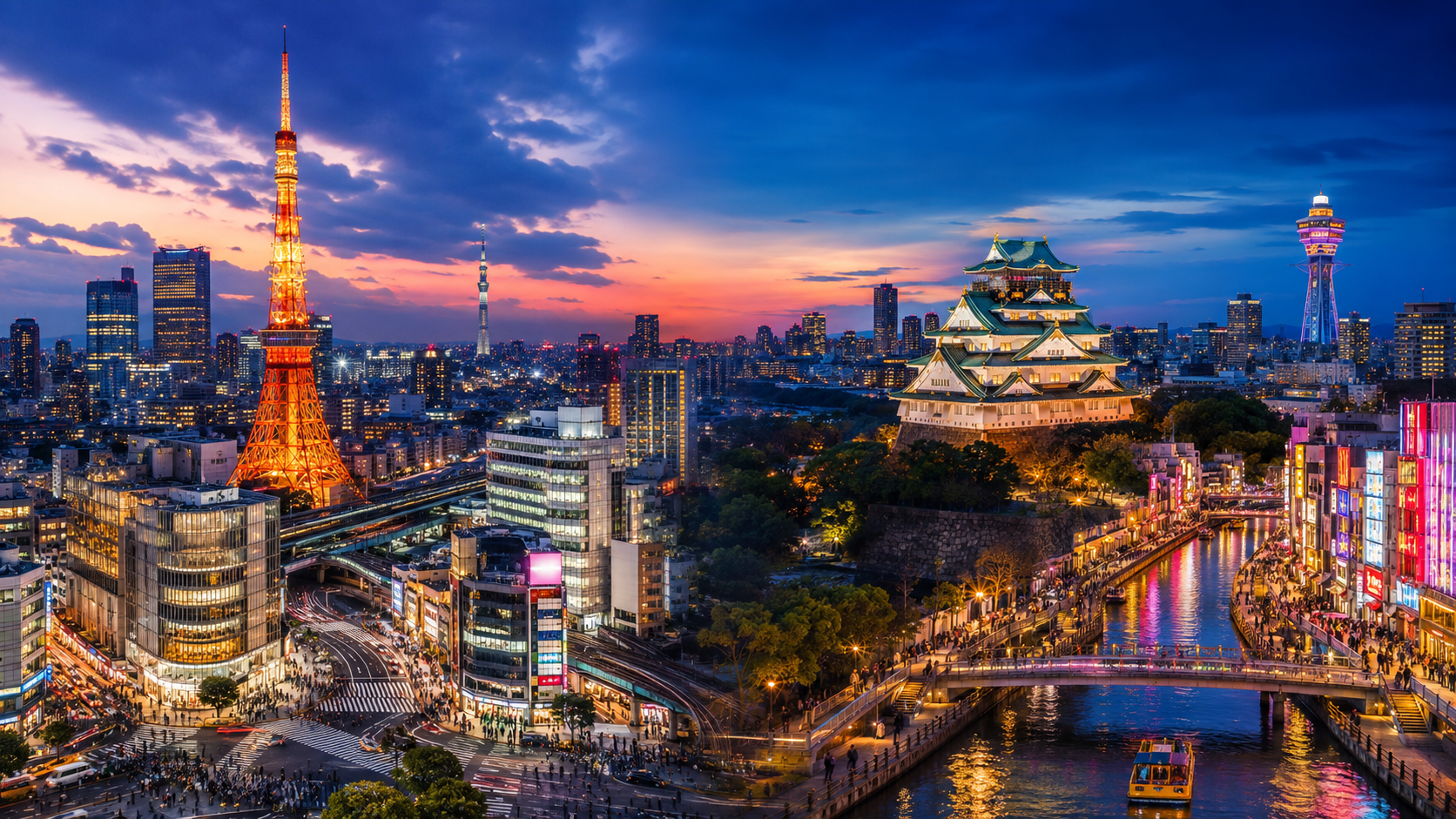
東京 vs 大阪 Tokyo & Osaka
Japan’s great internal argument — and the most delicious rivalry in the world.
KANTO REGION · KANSAI REGION · JAPAN
TOKYO
37M
METRO POPULATION
$1.1T+
METRO GDP
210
MICHELIN STARS
OSAKA
19M
METRO POPULATION
$340B+
METRO GDP
99
MICHELIN STARS
Ask any Japanese person which city they prefer and you’ll learn more about them in five seconds than in an hour of polite conversation. Tokyo and Osaka are not just different cities — they are different arguments about what Japan is and what it should be.
They sit two and a half hours apart on the Shinkansen. They share a language, a culture, a cuisine, and a flag. And yet Tokyoites and Osakans view each other with an affectionate, competitive suspicion that goes back centuries. Tokyo is the capital — formal, meticulous, self-contained. Osaka is the merchant city — warm, direct, and built around the pleasure of eating and being together. This is Japan’s greatest internal debate, and there is no right answer. Only preferences.
01 —
Character & Personality
TOKYO
Tokyo is the capital city in every sense — formal, polished, and slightly reserved. There is a famous Japanese concept of tatemae, the public face one presents to the world, and Tokyo is its highest expression. People dress carefully, speak considerately, and maintain a studied distance in public. This is not coldness — it is respect, enacted as civic behaviour. Tokyo’s personality is like a beautifully wrapped gift: the more layers you remove, the more considered the contents turn out to be. It takes time, but it rewards patience in full.
OSAKA
Osaka is the city that breaks the rules of Japanese social convention — and does so with a grin. Osakans are famous across Japan for their warmth, their directness, and their compulsive need to be funny. The Kansai dialect (Osaka-ben) is broader, warmer, and more expressive than standard Tokyo Japanese. Strangers will strike up conversations with you on the street. Shopkeepers will joke with you. The city runs on nori — a word that roughly translates as going with the flow, playing along, keeping the energy up. Osaka doesn’t need to be discovered. It introduces itself.
“Tokyo keeps its best things hidden. Osaka puts its best things on the street and dares you not to stop.”
02 —
Food
Osaka has a saying: kuidaore — “eat until you drop.” It is the city’s unofficial motto, its civic religion, and its most honest self-description. The food rivalry between Tokyo and Osaka is the most passionately contested debate in Japanese culture, and both sides have a case.
TOKYO
Tokyo’s food culture is about mastery and precision. With more Michelin stars than any other city on Earth, it is the home of the shokunin — the master craftsperson who devotes a lifetime to a single dish. The sushi here is the benchmark against which all other sushi is measured. The ramen is a serious philosophical exercise. Even the convenience store onigiri is assembled with care. Tokyo food rewards attention and reverence. You eat quietly, individually, and with focus. The experience is closer to performance than sustenance.
OSAKA
Osaka’s food culture is about pleasure, abundance, and community. Takoyaki — octopus balls cooked in iron moulds on the street — is the city’s soul food, eaten standing up, burning your fingers, drizzled with mayo and bonito flakes. Okonomiyaki, the savoury cabbage pancake you cook yourself at the table, is a social event as much as a meal. Kushikatsu — skewered, battered, deep-fried everything — is Osaka’s greatest contribution to world cuisine and strictly governed by one sacred rule: no double-dipping in the communal sauce. Osaka food is loud, generous, and almost aggressively delicious.
“Tokyo asks you to appreciate the food. Osaka asks you to enjoy it. Both are right.”
03 —
Neighbourhoods & Atmosphere
TOKYO
Tokyo is a federation of distinct worlds — Asakusa’s old Edo atmosphere, Daikanyama’s curated cool, Akihabara’s electric subcultures, Yanaka’s quiet lanes. Each neighbourhood has its own personality, its own rhythm. The city rewards wandering: turn down an unmarked alley in Shinjuku and you might find a six-seat whisky bar that’s been there for 40 years. Tokyo’s geography is vast and occasionally overwhelming, but its density means that extraordinary things are always within walking distance of ordinary ones.
OSAKA
Osaka is more navigable but no less layered. Dotonbori — the neon-lit canal strip — is the city’s famous face, all glowing billboards and street food and crowds. But the real Osaka reveals itself in Shinsekai, the retro entertainment district built for a 1903 World Expo and still magnificent in its faded swagger, and in Hozenji Yokocho, a tiny stone-paved alley of old restaurants where moss grows on a water-splashed Buddha statue and nothing seems to have changed in 70 years. Osaka’s soul is in these pockets of stubborn, cheerful continuity.
04 —
Cost & Practicalities
TOKYO
Tokyo’s reputation as an expensive city has been thoroughly dismantled by the weak yen — it now represents extraordinary value for most international visitors. The transit system is the world’s most comprehensive and reliable. Accommodation ranges from capsule hotels at ¥3,000 a night to some of Asia’s finest luxury properties. Navigation is intuitive with a Suica card and Google Maps. The city is large, though — getting from one neighbourhood to another can take 30–40 minutes even with efficient trains, so accommodation location matters more in Tokyo than almost anywhere.
OSAKA
Osaka is slightly cheaper than Tokyo across the board — accommodation, food, and transport all come in a little lower. The city is also considerably more compact, meaning you can cover more of it on foot and spend less time commuting between attractions. It serves as an excellent base for day trips to Kyoto (15 minutes by Shinkansen), Nara (45 minutes), and Kobe (20 minutes) — making it arguably the most strategically positioned city in Japan for a first-time visitor wanting to see the country’s cultural heartland.
05 —
The Verdict
Tokyo and Osaka are not opposites — they are complements. Japan makes most sense when you’ve seen both. But if you have to choose, here is the honest breakdown.
If you want…
Go to…
World’s best sushi and ramen
Tokyo
World’s best street food
Osaka
Quiet, precise, layered experiences
Tokyo
Warmth, humour, and human connection
Osaka
Vast urban exploration
Tokyo
A base for Kyoto, Nara & Kobe
Osaka
The full depth of Japanese subculture
Tokyo
The soul of everyday Japanese life
Osaka
First visit to Japan
Osaka (then Tokyo)
Return visit to Japan
Tokyo (then Osaka again)
First-time visitors to Japan often make the mistake of spending all their time in Tokyo. It is a magnificent city — possibly the best in the world — but it is not all of Japan. Osaka is the corrective: louder, messier, funnier, and in some ways more nakedly human. A week split between them, with a day in Kyoto from Osaka, is close to the ideal first encounter with this country.
The Japanese themselves will never resolve this debate. Osakans think Tokyoites are uptight. Tokyoites think Osakans are exhausting. Both are a little bit right. Both cities are extraordinary. The argument, like all the best arguments, is the point.
Tokyo will change how you think. Osaka will change how you eat. Japan needs both of them — and so do you.
Star counts above are totals from the MICHELIN Guide 2026 selections: Tokyo lists 12 three-star, 26 two-star and 122 one-star restaurants (210 stars across 160 restaurants); Osaka lists 3 three-star, 12 two-star and 66 one-star (99 stars across 81 restaurants).
To provide the best experiences, we use technologies like cookies to store and/or access device information. Consenting to these technologies will allow us to process data such as browsing behavior or unique IDs on this site. Not consenting or withdrawing consent, may adversely affect certain features and functions.
Functional
Always active
The technical storage or access is strictly necessary for the legitimate purpose of enabling the use of a specific service explicitly requested by the subscriber or user, or for the sole purpose of carrying out the transmission of a communication over an electronic communications network.
Preferences
The technical storage or access is necessary for the legitimate purpose of storing preferences that are not requested by the subscriber or user.
Statistics
The technical storage or access that is used exclusively for statistical purposes.The technical storage or access that is used exclusively for anonymous statistical purposes. Without a subpoena, voluntary compliance on the part of your Internet Service Provider, or additional records from a third party, information stored or retrieved for this purpose alone cannot usually be used to identify you.
Marketing
The technical storage or access is required to create user profiles to send advertising, or to track the user on a website or across several websites for similar marketing purposes.


Leave a Reply