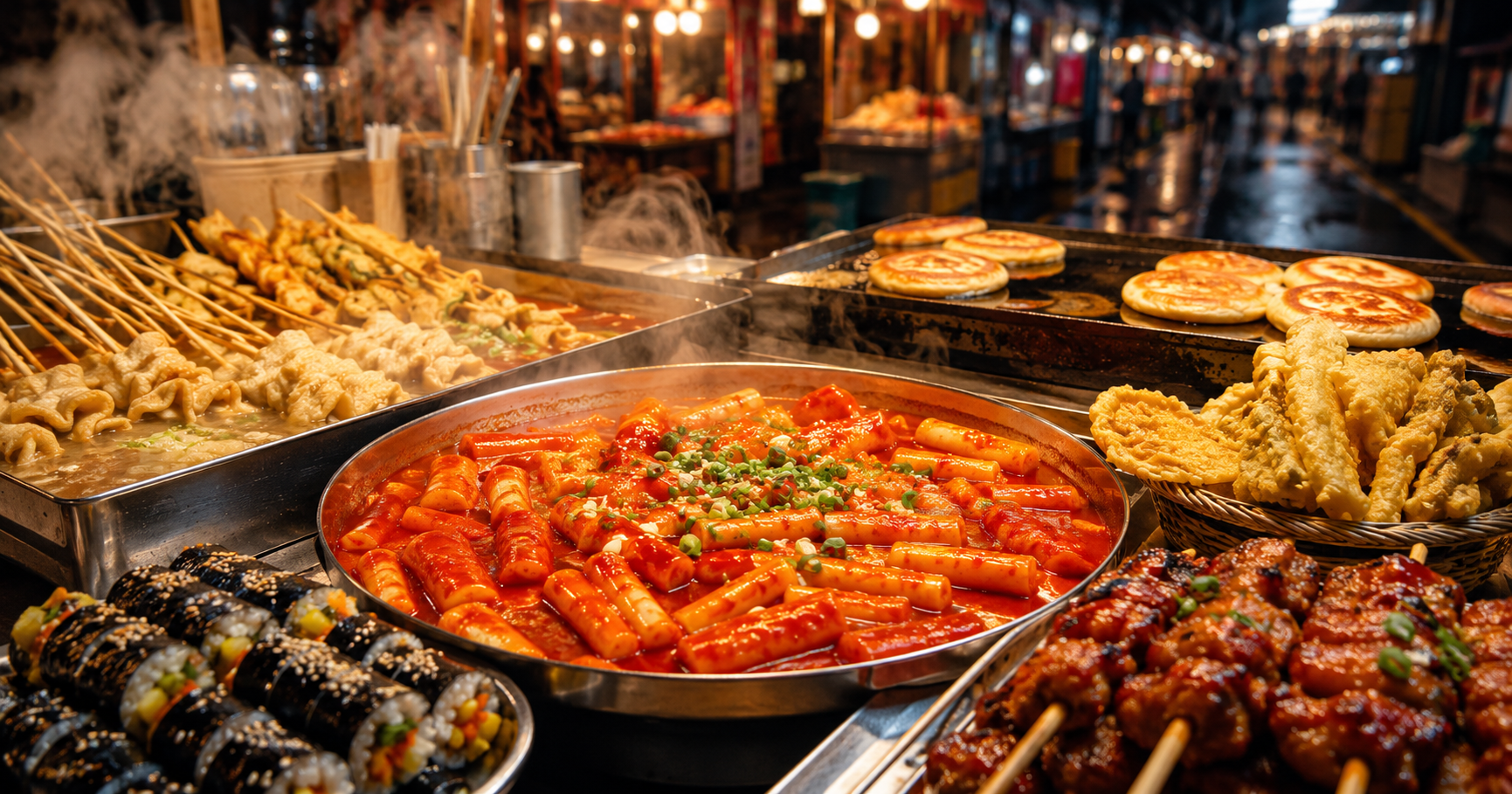
KOREA FOOD GUIDE — 길거리 음식 시리즈
한국 길거리 음식 Top 10
Korea’s Greatest Street Foods
포장마차에서 분식집까지 — 한국 길거리 음식 문화의 정수 열 가지. From pojangmacha carts to bunsikjip counters — the ten street foods that define Korean food culture.
서울 · 부산 · 전국 어디서나 · ALL ACROSS KOREA
한국의 길거리 음식은 단순한 간식이 아니다. Korea’s street food is not a category of lesser food. It is the most democratic and arguably the most honest expression of what Korean cuisine actually is — bold, communal, deeply flavoured, and designed to be eaten standing up, in company, with cold weather outside and hot food in your hands. The pojangmacha cart with its orange tent flapping in the evening wind is as much a cultural institution as any Michelin-starred dining room.
These ten foods are the ones that have defined Korean street food culture across generations — eaten by schoolchildren, office workers, late-night revellers, and grandmothers with equal enthusiasm. They are found everywhere from Seoul’s Myeongdong to Busan’s Gukje Market to small-town evening markets that only open on weekends. Each one tells you something true about Korea. 이 열 가지 음식을 먹어보면 한국을 이해하기 시작할 수 있다.
01
전국 어디서나 · NATIONWIDE · 분식 BUNSIK
떡볶이 Tteokbokki
한국 길거리 음식의 왕, 떡볶이. If Korea had a national street food, it would be tteokbokki — and the argument would not be close. Cylindrical rice cakes (garae-tteok) simmered in a sauce of gochujang (fermented red chilli paste), gochugaru (chilli flakes), soy sauce, garlic, and sugar until they become chewy, deeply spicy, and almost caramelised at the edges — this is the dish that every Korean grew up eating after school, the one that appears at every pojangmacha and bunsik counter, the one that has been elevated into fine dining tasting menus and yet remains most itself in a paper cup by the roadside. The base recipe has countless regional and personal variations: some add fish cakes (eomuk), some add boiled eggs, some use a doenjang-based sauce, some go cream-based for a milder version. But the original — the bright red, aggressively seasoned, deeply satisfying original — is the one that matters. 매운맛, 단맛, 쫄깃한 식감의 완벽한 조화. 한국인의 소울 푸드.
| 🌶️ 맵기 Spice Level | Medium–Hot (조절 가능 / adjustable) |
| 💰 가격대 Price | ₩3,000 – ₩6,000 per serving |
| 🕐 Best Time | 방과 후 & 야식 After school & late night |
| 📍 어디서 Where | 모든 분식집, 포장마차, 시장 / All bunsik shops, pojangmacha, markets |
어디서 먹을까 Where to eat: Sindang-dong Tteokbokki Town (신당동 떡볶이 타운) in Seoul for the original style. Gwangjang Market for a classic pojangmacha version. Anywhere — truly anywhere — in Korea.
02
전국 어디서나 · NATIONWIDE · 분식 BUNSIK
순대 Sundae
순대는 한국의 소울 푸드다 — 서양인들이 처음엔 주저하다가 한 번 먹으면 반하는 음식. Korean blood sausage — sundae — is one of the most misunderstood and most beloved foods in the country. Glass noodles, barley, and pork blood are packed into natural casing and steamed until the filling is soft and fragrant, then sliced into rounds and served with a dipping sauce of salt and gochujang, alongside blanched organ meats if you order the full plate. The flavour is mild, earthy, and deeply savoury — far gentler than European blood sausages, with none of the iron-heaviness that puts people off. Eaten with a smear of salt and a piece of liver or lung at a market stall, it is one of the most satisfying two-bite combinations in Korean food. Street stalls pile it into paper cups for eating on the go. Bunsik restaurants serve it with tteokbokki and ramen broth. It is everywhere, it is inexpensive, and it is wonderful. 처음엔 낯설지만 먹어보면 반드시 다시 찾게 되는 맛.
| 🌶️ 맵기 Spice Level | Mild (소금장과 함께 / served with salt dip) |
| 💰 가격대 Price | ₩3,000 – ₩8,000 per serving |
| 🕐 Best Time | 점심, 간식, 야식 Lunch, snack, late night |
| 📍 어디서 Where | 시장, 분식집, 포장마차 / Markets, bunsik, pojangmacha |
어디서 먹을까 Where to eat: Majang Sundae Town (마장동 순대타운) for the full experience. Any traditional market sundae stall for the street version. Order 모둠순대 (mixed plate) to try different varieties.
03
전국 어디서나 · NATIONWIDE · 포장마차 POJANGMACHA
어묵 (오뎅) Eomuk / Oden
겨울 길거리의 가장 따뜻한 위안, 어묵 국물 한 모금. Fish cake skewers simmered in a light, savoury dashi-style broth are one of Korea’s most elemental street food experiences — and one that is almost impossible to explain adequately to someone who hasn’t stood at a pojangmacha cart in November, hands wrapped around a paper cup of hot broth, while the city moves around you. The fish cakes themselves — made from minced white fish, starch, and seasoning, formed into sheets, rolls, or tubes and skewered on wooden sticks — have a gentle, yielding texture and a subtly oceanic flavour. But the broth is the soul of the dish: deeply savoury, perpetually simmering, ladled free into paper cups as a matter of course. You drink the broth between bites. You stay longer than you planned. It costs almost nothing and feels like everything. 한국 겨울의 필수품, 어묵 국물은 공짜라는 사실을 잊지 말자.
| 🌶️ 맵기 Spice Level | Mild (국물은 순함 / broth is mild) |
| 💰 가격대 Price | ₩500 – ₩1,500 per skewer |
| 🕐 Best Time | 가을·겨울 Autumn & winter evenings |
| 📍 어디서 Where | 포장마차, 시장, 분식집 어디서나 / Pojangmacha, markets everywhere |
어디서 먹을까 Where to eat: Any pojangmacha cart in autumn or winter. Busan’s Gukje Market (국제시장) has outstanding versions. Remember: the broth refill is always free — 국물은 공짜.
04
전국 어디서나 · NATIONWIDE · 튀김 TUIGIM
호떡 Hotteok
호떡은 한국 겨울 거리의 가장 달콤한 상징이다. Hotteok is the sweet street food that stops you mid-stride on a cold day and keeps you there. A disc of soft, slightly chewy wheat dough is filled with a mixture of brown sugar, cinnamon, and crushed peanuts or seeds, then pressed flat onto a hot griddle with a circular iron press and cooked until the exterior is golden and slightly crisp while the interior turns into liquid caramel. The first bite — careful, because the filling is volcano-hot — releases a flood of dark, sweet, aromatic syrup that has no equivalent in any other cuisine. It costs next to nothing. It is made in minutes. And it produces a specific happiness that is entirely out of proportion to its simplicity. The savoury version (씨앗호떡), made with mixed seeds rather than sugar, has become a Busan speciality and a worthy alternative for those who prefer their street food less sweet. 한 입 베어 물면 뜨거운 흑설탕 시럽이 흘러나오는 한국 겨울의 맛.
| 🌶️ 맵기 Spice Level | Not spicy — sweet (달콤함) |
| 💰 가격대 Price | ₩1,000 – ₩2,000 each |
| 🕐 Best Time | 가을·겨울 Autumn & winter — the cold makes it better |
| 📍 어디서 Where | 시장, 거리 노점 / Traditional markets, street stalls |
어디서 먹을까 Where to eat: Insadong (인사동) street in Seoul for the classic version. Busan’s Gukje Market for the seed hotteok (씨앗호떡). Any traditional market in autumn or winter. Wait 30 seconds before biting — the filling is dangerously hot.
05
광장시장 · 전통시장 · TRADITIONAL MARKETS
빈대떡 Bindaetteok
광장시장의 빈대떡은 서울에서 가장 맛있는 음식 중 하나다 — 미슐랭 스타 레스토랑을 포함해서. Bindaetteok — mung bean pancakes — are one of the oldest and most deeply traditional foods in Korean cuisine, and Gwangjang Market in Seoul has become their spiritual home. Ground mung beans are mixed with pork, kimchi, and green onions, formed into thick discs, and fried in a generous pour of oil until the exterior is shatteringly crisp and golden while the interior remains creamy and dense. The contrast in texture — crisp shell, soft centre — is extraordinary. The flavour is nutty, savoury, and complex in a way that requires no explanation or embellishment. Eaten at a market stall with a cup of makgeolli (Korean rice wine, the traditional pairing), bindaetteok is one of the most satisfying afternoon experiences Seoul offers. 녹두의 고소함, 돼지고기의 풍미, 김치의 신맛이 만나는 완벽한 조화.
| 🌶️ 맵기 Spice Level | Mild–Medium |
| 💰 가격대 Price | ₩4,000 – ₩8,000 per pancake |
| 🕐 Best Time | 오후 간식 Afternoon snack with makgeolli |
| 📍 어디서 Where | 광장시장, 전통시장 / Gwangjang Market, traditional markets |
어디서 먹을까 Where to eat: Gwangjang Market (광장시장) — the definitive destination. Order makgeolli (막걸리) alongside. Eat immediately while still hot and crisp. Do not reheat — it is never as good the second time.
06
전국 어디서나 · NATIONWIDE · 닭 CHICKEN
닭꼬치 Dak Kkochi
닭꼬치는 한국 야시장의 대표 메뉴다. Korean chicken skewers are the street food that bridges generations and occasions — equally at home at a school festival, a night market, a pojangmacha, or a convenience store forecourt. Pieces of chicken — thigh meat, usually — are threaded onto bamboo skewers, grilled over charcoal or a gas flame, and brushed repeatedly with a sweet-and-spicy sauce that builds in depth and caramelisation with each layer. The best versions have a slight char on the exterior, juicy meat within, and a sauce that is simultaneously sweet, salty, and faintly smoky. The simpler salted version (소금 닭꼬치) — just chicken, salt, and a final brush of butter — reveals the quality of the meat more nakedly and is the version serious eaters often prefer. Eaten on the street with paper napkins and fingers sticky with sauce, it is one of Korea’s most elemental pleasures. 숯불 향과 달콤 매콤한 소스가 만들어내는 중독적인 맛.
| 🌶️ 맵기 Spice Level | Medium (양념) / Mild (소금) — choose your style |
| 💰 가격대 Price | ₩1,500 – ₩3,000 per skewer |
| 🕐 Best Time | 저녁, 야시장 Evening, night markets |
| 📍 어디서 Where | 야시장, 거리 노점, 편의점 앞 / Night markets, street stalls, convenience stores |
어디서 먹을까 Where to eat: Myeongdong street food alley (명동 거리) for the tourist-friendly version. Any evening market (야시장) for the most authentic experience. Dongdaemun night market area for late-night cravings.
07
광장시장 · GWANGJANG MARKET · 육류 MEAT
마약 김밥 Mayak Kimbap
마약 김밥 — 중독성 있다는 뜻의 이름이 전혀 과장이 아니다. “Narcotic kimbap” — the nickname is not hyperbole. These tiny rolls, barely larger than a coin in diameter, have been made at Gwangjang Market in Seoul since the 1970s by the same family stall, and the queue has never stopped forming. The recipe is deceptively simple: short-grain rice, yellow pickled radish (danmuji), and carrot rolled in a thin sheet of seasoned seaweed (gim), sliced into bite-sized rounds, and served with a dipping sauce of soy, sesame oil, and a touch of mustard. The genius is in the proportions — the rice-to-filling ratio, the quality of the seaweed, the specific combination of sauce elements — and in the fact that you cannot eat just one. The moment you finish a portion you are already calculating whether to order another. They cost almost nothing. They are impossible to stop eating. The name is earned. 한 번 먹기 시작하면 멈출 수 없는, 이름 그대로의 마약 같은 맛.
| 🌶️ 맵기 Spice Level | Not spicy (순한 맛) |
| 💰 가격대 Price | ₩3,000 – ₩5,000 per portion |
| 🕐 Best Time | 언제든지 Any time of day |
| 📍 어디서 Where | 광장시장 전용 / Gwangjang Market — the original and best |
어디서 먹을까 Where to eat: Gwangjang Market (광장시장) — specifically the original stall in the covered market. Order two portions minimum. Dip fully in the sauce before each piece. Do not share.
08
전국 어디서나 · NATIONWIDE · 튀김 FRIED
튀김 Twigim (Korean Fried Snacks)
한국의 튀김은 단순한 튀김이 아니다 — 그것은 하나의 예술 형식이다. Korean street-style frying is a category unto itself — a collection of individually battered and fried items served together from a glass-fronted cart that smells like every good thing at once. The standard lineup includes sweet potato (goguma), zucchini (hobak), squid (ojingeo), stuffed green chilli (gochujang-filled), and the triumphant twigim mandu — deep-fried dumplings that achieve a crackling golden crust around a juicy, savoury filling. Everything is dipped in a thin, light batter and fried to order, then served in a paper bag with a ladleful of tteokbokki sauce for dipping. The combination of hot, crisp tuigim with the sweet-spicy sauce is one of the defining flavour combinations of Korean street food. It costs almost nothing and demands absolutely nothing of the eater except presence and appetite. 바삭하게 튀긴 각종 재료들, 소스에 찍어 먹는 순간 행복해지는 맛.
| 🌶️ 맵기 Spice Level | Mild–Medium (소스 덕분에 / depending on sauce) |
| 💰 가격대 Price | ₩500 – ₩1,500 per piece |
| 🕐 Best Time | 방과 후, 야식 After school, late night snack |
| 📍 어디서 Where | 분식집, 포장마차, 시장 어디서나 / Bunsik, pojangmacha, markets |
어디서 먹을까 Where to eat: Any bunsik shop or pojangmacha cart — this is universally available across Korea. Order a mixed bag (모듬 튀김) and ask for extra tteokbokki sauce. Always eat immediately — twigim waits for no one.
09
명동 · 야시장 · MYEONGDONG & NIGHT MARKETS · 디저트 DESSERT
계란빵 Gyeran-ppang (Egg Bread)
계란빵은 단순하지만 완벽한 한국의 겨울 길거리 디저트다. Egg bread is the most comforting and most photographed street food in modern Seoul — a small, slightly sweet bread roll baked in a fish-shaped or oval iron mould with a whole egg cracked directly into the batter before baking, so that the finished product contains a softly set egg inside a warm, tender, lightly sweet bread. The egg is the surprise and the point: the bread is pleasant but ordinary; the whole egg nestled inside, still slightly yielding at the yolk, transforms it into something unexpectedly satisfying. Street carts sell them freshly baked, two for ₩2,000, the vendor turning them in their moulds with practised efficiency. They are the food you eat while walking, while window shopping, while waiting for a friend. They warm your hands before they warm your stomach. In Myeongdong on a winter evening, the smell of egg bread baking is inseparable from the experience of being in Seoul. 따뜻한 계란빵 두 개, 차가운 겨울 밤의 완벽한 동반자.
| 🌶️ 맵기 Spice Level | Not spicy — sweet & savoury (달콤하고 고소함) |
| 💰 가격대 Price | ₩1,000 – ₩1,500 each |
| 🕐 Best Time | 가을·겨울 저녁 Autumn & winter evenings |
| 📍 어디서 Where | 명동, 야시장, 거리 노점 / Myeongdong, night markets, street carts |
어디서 먹을까 Where to eat: Myeongdong’s street food alley (명동 거리) in the evening. Any winter street market. Buy two — one is never enough. Eat while walking, while still warm.
10
부산 · 전국 야시장 · BUSAN & NIGHT MARKETS · 해산물 SEAFOOD
씨앗호떡 & 납작만두 Ssiat Hotteok & Napjak Mandu
부산의 두 가지 특산 길거리 음식이 하나의 항목을 공유할 자격이 충분하다. Two of Busan’s most distinctive street food specialities deserve their place on any list of Korea’s greatest — and their pairing is the perfect illustration of how regional variation enriches Korean street food culture. Ssiat hotteok (씨앗호떡) is the Busan evolution of the classic hotteok: instead of liquid sugar filling, a mixture of pumpkin seeds, sunflower seeds, and honey is pressed into the dough, producing a crunchier, more complex and less cloying result that has converted many people who found the sweet original too much. Napjak mandu (납작만두) are Busan’s flat dumplings — much thinner than regular mandu, pan-fried until both sides are golden and crackling, then served with a sharp dipping sauce. The filling is minimal — just enough to provide savour — because the point is the crisp, blistered pastry itself. Eaten together at a market stall with the harbour in the background, they are an argument for making the journey to Busan. 부산을 대표하는 두 가지 길거리 음식, 부산에 간다면 반드시 먹어야 할 것들.
| 🌶️ 맵기 Spice Level | 씨앗호떡: Not spicy / 납작만두: Mild |
| 💰 가격대 Price | ₩1,500 – ₩3,000 each |
| 🕐 Best Time | 언제든지 / 특히 가을·겨울 Any time, especially autumn & winter |
| 📍 어디서 Where | 부산 국제시장, 깡통시장 / Busan Gukje Market, Kkangtong Market |
어디서 먹을까 Where to eat: Busan’s Gukje Market (국제시장) and Kkangtong Market (깡통시장) in Nampo-dong for the definitive versions. Worth the trip from Seoul just for these two items alone.
한눈에 보기 — Quick Reference
| # | 음식 Food | 맵기 Spice | 가격 Price | 계절 Season | 어디서 Where |
|---|---|---|---|---|---|
| 01 | 떡볶이 Tteokbokki | 🌶️🌶️ | ₩3,000–6,000 | 사계절 | 전국 어디서나 |
| 02 | 순대 Sundae | 🌶️ | ₩3,000–8,000 | 사계절 | 시장, 분식집 |
| 03 | 어묵 Eomuk | — | ₩500–1,500/개 | 🍂❄️ 가을·겨울 | 포장마차, 시장 |
| 04 | 호떡 Hotteok | — | ₩1,000–2,000 | 🍂❄️ 가을·겨울 | 시장, 거리 노점 |
| 05 | 빈대떡 Bindaetteok | 🌶️ | ₩4,000–8,000 | 사계절 | 광장시장 |
| 06 | 닭꼬치 Dak Kkochi | 🌶️🌶️ | ₩1,500–3,000/개 | 사계절 | 야시장, 거리 노점 |
| 07 | 마약 김밥 Mayak Kimbap | — | ₩3,000–5,000 | 사계절 | 광장시장 |
| 08 | 튀김 Twigim | 🌶️ | ₩500–1,500/개 | 사계절 | 분식집, 포장마차 |
| 09 | 계란빵 Gyeran-ppang | — | ₩1,000–1,500 | 🍂❄️ 가을·겨울 | 명동, 야시장 |
| 10 | 씨앗호떡 & 납작만두 | —/🌶️ | ₩1,500–3,000 | 사계절 | 부산 국제시장 |
길거리 음식 필수 가이드 — Street Food Survival Tips
- 현금 준비 Bring Cash: 대부분의 포장마차와 노점상은 현금만 받는다. Most street food stalls and pojangmacha accept cash only — carry small bills (₩1,000 and ₩5,000 notes).
- 즉시 먹기 Eat Immediately: 한국 길거리 음식은 갓 만들었을 때가 최고다. Korean street food is made to be eaten on the spot — tuigim goes soft, hotteok loses its caramel, egg bread cools quickly. Don’t walk and save for later.
- 줄 서기 The Queue: 줄이 길면 맛있다는 뜻이다. In Korea, a long queue is the most reliable quality signal. If there’s a line, join it — you will not be disappointed.
- 포장마차 에티켓 Pojangmacha Etiquette: 자리를 잡으면 음식을 주문하고 자리를 지켜라. If you take a seat at a pojangmacha, you order food — it’s not a place to just drink. Soju and snacks together is the tradition.
- 야시장 Night Markets: 서울의 여의도, 반포, 한강 야시장은 봄·여름·가을에 운영한다. Seoul’s Han River night markets (여의도, 반포, 뚝섬) operate spring through autumn and are the best single locations for experiencing the full range of Korean street food.
- 비건·채식 주의 Vegan Note: 많은 길거리 음식에 어묵, 돼지고기 등 동물성 재료가 포함된다. Many Korean street foods contain fish cake, pork, or other animal products. Always ask (채식주의자예요 / 비건이에요) if dietary restrictions apply.
한국의 길거리 음식은 이 나라의 심장 소리다.
Korea’s street food is the heartbeat of this country — loud, generous, a little spicy, and impossible to resist.
Hungry for more? Pair this list with our guide to Seoul’s essential sit-down restaurants, explore the basement food halls of Korea’s finest department stores, or pick a base to stay from our Seoul hotel guide.


Leave a Reply