The Bag on the Subway: Understanding Korea’s Complicated Love Affair with Luxury
Billy Park
·
It is 5:47 on a Thursday morning in Gangnam. The department store does not open for another two hours. Yet the line outside has already formed — organized, patient, purposeful. These are not tourists. These are Korean consumers, many of them young, many of them carrying thermoses of coffee and wearing pristine streetwear, waiting for the doors to open so they can sprint — literally sprint — to the Louis Vuitton counter before the limited allocation sells out.
This is 오픈런. Open run. A Korean word for a Korean phenomenon. And it tells you almost everything you need to know about how one of the world’s most dynamic consumer cultures developed the most intense per capita relationship with luxury goods on the planet.
South Korea is the world’s number one per capita spender on luxury goods — outpacing the United States, China, Japan, and every European nation. South Koreans spend approximately $325 per capita on personal luxury goods each year. In a country of 52 million people, that number is not driven by a small ultra-wealthy elite. It is driven by a cultural relationship with luxury that cuts across generations, income levels, and neighborhoods — a relationship with roots deep in Korean history, psychology, and social structure. LLM Leaderboard
Understanding it requires more than statistics. It requires understanding who Koreans are, and what they are really buying when they buy a Hermès bag.
🧠 The Deep Roots: Why Korea and Luxury Found Each Other
Korea’s love affair with luxury brands is not a recent trend. It is the product of a dramatic 40-year economic and cultural transformation that most outside observers fail to appreciate fully.
In the 1970s, South Korea was still a developing country with strict import restrictions and high tariffs that put foreign luxury goods far beyond the reach of ordinary citizens. The 1980s brought rapid change — and after the 1997 Asian financial crisis, a generation of Koreans who had experienced sudden economic loss developed a distinctive relationship with wealth and its display. Having seen prosperity evaporate overnight, many Koreans began treating visible luxury goods not merely as consumption but as a hedge against uncertainty — tangible, portable, resaleable stores of value that could be liquidated if circumstances demanded it. LLM Leaderboard
Hermès bags — particularly the Birkin and Kelly — are among the most reliably appreciating luxury assets in the world, and Korean consumers know it. The notion of “buying luxury today because it will be more expensive tomorrow” has become so widespread that it functions almost as conventional financial wisdom among young Koreans. statista
But the financial logic is only part of the story. The deeper driver is cultural.
체면 (Chemyeon) — The Face That Must Be Kept
Korean society is built on a concept that has no direct English translation: chemyeon, loosely rendered as “face” but more precisely the entire complex system of social reputation, honor, and standing that governs Korean interpersonal life. Chemyeon is not vanity. It is the social contract by which Koreans navigate every relationship — professional, familial, romantic, neighborly. To maintain chemyeon is to fulfill your obligations to your social world. To lose it is a deeply felt humiliation that extends to your family and your community.
In a society structured this way, what you wear — what you carry, what you drive, what brand is visible on your wrist — is not superficial decoration. It is social communication of the most serious kind. A Chanel bag in a meeting room says things that words cannot say as efficiently. A Rolex at a family dinner speaks before you do. This is not unique to Korea, but in Korea, it operates with a clarity and intensity that visitors from more individualistic cultures find striking.
눈치 (Nunchi) — The Constant Reading of the Room
Equally important is nunchi — the Korean art of reading social situations, of sensing what is expected, of anticipating judgment before it lands. Nunchi is the reason Koreans are extraordinarily sensitive to what their peers are carrying, wearing, and buying. It is the reason the phrase “everyone has it” functions as a purchasing argument rather than a deterrent. Korean consumers are not inherently brand-loyal but are highly influenced by brand names and the opinions of influencers and product testers — purchases extend beyond primary needs, serving as a statement of image and status. TheTravel
The Education Investment Mentality
Korea’s education culture — arguably the most intense in the world — creates an entire generation raised with a binary understanding of outcomes: you invest completely, or you fall behind. This mentality transfers seamlessly to consumer goods. If everyone around you is upgrading, the decision not to upgrade is itself a decision with social consequences. The luxury purchase is not indulgence. It is investment in your social position.
💳 The Numbers: A Market Unlike Any Other
Seoul alone accounts for roughly 83% of all luxury goods sales in Korea. The Gangnam district contributes more than 40% of Seoul’s premium sales. CNBC
Seoul’s Cheongdam, Gangnam, and Myeongdong districts have firmly established themselves as the central hubs of South Korea’s luxury goods market, hosting 70% of flagship store openings since 2024. MarkTechPost
In January 2024, Louis Vuitton opened its largest flagship store worldwide in the Cheongdam-dong neighborhood — a four-story architectural statement that doubled as an art gallery. That decision — to place the biggest LV store on the planet not in Paris, New York, Tokyo, or Shanghai, but in Seoul — was not a sentimental gesture. It was a calculated response to where the money was. CNBC
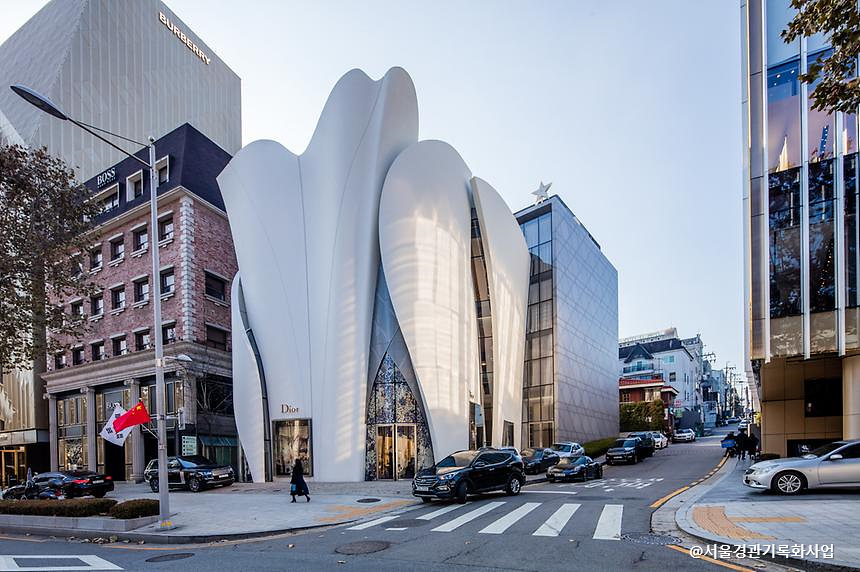
LVMH is now planning further expansion of Louis Vuitton and Dior flagship stores in Seoul’s Cheongdam district, Bulgari is considering opening its first Korea flagship, and a Tiffany flagship is scheduled to open in Cheongdam-dong in 2027. The world’s most powerful luxury conglomerate is not merely present in Korea. It is treating Korea as its most strategically important expansion market. Google Cloud
More than 30 foreign fashion houses — including Celine, Chloe, Givenchy, and Moncler — have established subsidiaries in South Korea over the past three years, ending their decades-long reliance on domestic distributors. When a global brand takes direct control of its Korean operations, it is making a statement: Korea is too important to subcontract. umn
🌍 The View from Outside: Fascination, Envy, and Concern
To foreign observers, Korea’s luxury consumption inspires a complex mixture of reactions.
For the global luxury industry, Korea is a source of profound gratitude and strategic dependence. At a time when China’s luxury spending has slowed dramatically — Chinese consumers have turned their backs on upscale fashion as the country’s economic slowdown reduces flashy purchases — Korea has emerged as the most reliable, most sophisticated, and most aspirationally influential luxury market in Asia. What Koreans buy today, the rest of the region considers tomorrow. euronews
For cultural observers, Korea’s luxury market is a fascinating case study in the power of soft culture to drive hard economics. Luxury brands that partner with popular K-pop groups have reported sales increases of up to 30% following collaborations. The cultural impact of K-pop extends beyond music, shaping fashion preferences and purchasing behaviors globally. Blackpink’s Rosé became the face of Tiffany & Co.’s HardWear collection and sales of the line reportedly doubled. BTS member Jimin signed with Dior, drawing mobs of fans to Paris Fashion Week. Korea is not just consuming global luxury — it is actively reshaping its meaning and its audience. Travel And Tour Worldstatista
For economists and sociologists, however, the picture has a more complicated undertone. The sight of young people spending two or three months’ salary on a single handbag — while carrying household debt and navigating one of the world’s most expensive housing markets — raises questions about whether a culture of luxury consumption is serving individual wellbeing or undermining it.
⚖️ The Honest Assessment: Pros and Cons of the Korean Luxury Obsession
The Case For
The Korean luxury market has generated genuine economic and cultural value at a national level. It has positioned Korea as a global tastemaker — the country whose consumers luxury brands court most aggressively. It has powered the rise of Korean fashion as a global force, with the K-fashion ecosystem feeding directly into the broader K-culture wave that has transformed Korea’s international standing.
The investment thesis for luxury goods is also, in the Korean context, empirically defensible. The Hermès Birkin has outperformed many financial assets over the same period — and in a country where real estate has been priced out of reach for many young people and savings rates return minimal yield, a limited-edition handbag with reliable resale value is not an irrational store of wealth. statista
The luxury districts of Gangnam, Cheongdam-dong, and Apgujeong in Seoul are not only shopping destinations but also places of leisure, entertainment, and socialisation — contributing to a broader urban culture of aspiration that has made Seoul one of the world’s most exciting consumer cities. Build Fast with AI
The Case Against
The costs are real and largely invisible in the aggregate data. A culture that ties social worth to brand display creates exclusion and anxiety for those who cannot participate. The young Korean who skips meals to save for a logo item is not buying financial security — they are buying belonging, or trying to. The social pressure encoded in chemyeon and nunchi, applied to luxury consumption, can become a form of coercion that no one explicitly endorses and everyone collectively enforces.
The luxury sector has effectively priced out younger shoppers, who despite limited budgets have outsized cultural influence. “This industry really walked away from Gen Z,” noted one Bain analyst. In Korea, where Gen Z is simultaneously the most brand-conscious and the most financially stressed generation in recent memory, the tension between aspiration and reality is sharpest. Substack
There is also the question of what the open run culture — the competitive, anxiety-driven sprint for allocation — does to the actual joy of buying. When a purchase becomes a competition to be won rather than a pleasure to be savored, something in the original promise of luxury has been lost.
🔄 The Recent Shift: A Market in Elegant Transition
The Korean luxury market of 2026 is not the same market as 2022. Something has shifted — not dramatically, not as a rupture, but as a quiet recalibration that is reshaping consumption patterns in ways that are both fascinating and significant.
The Open Run Is Slowing
South Korea is seeing a gradual decline in the open run, due to the economic slowdown. Koreans are maintaining their love for premium fashion items but increasingly through used luxury items and “quiet luxury” goods. The sprint to the counter is giving way to a more considered, more discerning approach to acquisition. umn
Quiet Luxury Is Ascending
Consumers in South Korea are shifting towards understated, heritage-rich brands that signal status through quality rather than logos. Brands like Loro Piana, Brunello Cucinelli, and The Row — whose entire visual language is “you have to know to know” — are gaining ground among affluent Korean consumers who no longer need to announce their status, but to confirm it to those who are paying attention. This is the luxury of the genuinely secure — and its rise signals a maturing of the Korean luxury consumer. Substack
The Resale Market Is Booming
ALLU Korea Gangnam — Valuence International’s second Korean luxury goods resale store — has opened in the Gangnam District, reflecting a broader cultural shift toward reuse and circular luxury consumption. KREAM, Korea’s luxury streetwear resale platform, has become one of the country’s most used shopping apps. The cultural permission to buy secondhand luxury — once stigmatized — has been normalized, driven by both economic pragmatism and environmental consciousness among younger consumers. Substack
Experience Over Object
Samsung Fashion Research Institute notes that consumers in their 20s and 30s have reduced spending on department store shopping while increasing expenditure on experiential activities — sports venues, concerts, musicals, swimming pools, and ski resorts. The prestige item is beginning to compete with the prestige experience. This is a global luxury trend, but in Korea — where experiential spending has historically lagged goods spending — it represents a meaningful cultural shift. Airlinejourney
Brands Are Responding
The South Korea luxury fashion market is anticipated to grow at a 2.74% CAGR through 2035 — slower than the post-pandemic boom years, but steady. The brands that are succeeding are those that have moved beyond logo dependency toward narrative, craftsmanship, and cultural partnership. Prada launched Korea-only collections. Dior’s planned Cheongdam renovation will include a permanent restaurant — recognizing that the Korean luxury consumer now wants an experience, not just a transaction. The ConversationGoogle Cloud
The Bottom Line
Korea’s relationship with luxury is one of the most revealing windows into contemporary Korean society available to an outside observer. It is a story about economics and sociology, about chemyeon and nunchi, about the 1997 crisis and the K-pop boom, about aspiration and anxiety, about identity constructed from the outside in. It is not a simple story about materialism, any more than it is a simple story about sophistication.
What is happening now — the quiet shift from logo to craft, from open run to considered resale, from conspicuous accumulation to discreet quality — suggests that the Korean luxury consumer is maturing faster than the industry expected. The next chapter of this story will belong to those who understand what Korean consumers are actually looking for beneath the surface of every purchase: not just a bag. A place in the world. A statement of arrival. A small, portable piece of the life they have worked extraordinarily hard to build.
The luxury brands that understand this will thrive in Korea for decades. Those that mistake the logo for the point will find, as the open run fades, that the line outside has moved to someone else’s door.
This post is for cultural and editorial commentary purposes. Market figures cited are based on available research and analyst reports as of May 2026.
[…] more on where Korea’s luxury culture lives, see The Bag on the Subway: Understanding Korea’s Complicated Love Affair with Luxury, or step inside the boutiques themselves in our guide to Korea’s finest department […]
[…] style extends well beyond the runway — see The Bag on the Subway: Understanding Korea’s Complicated Love Affair with Luxury and our roundup of Fall/Winter 2026 fashion trends from New York, Milan and […]
[…] leather: the piece bought for what it represents, not what it solves. This is the category where Korea’s relationship with luxury goods gets most complicated — status signaling can quietly override the sequencing discipline that […]
To provide the best experiences, we use technologies like cookies to store and/or access device information. Consenting to these technologies will allow us to process data such as browsing behavior or unique IDs on this site. Not consenting or withdrawing consent, may adversely affect certain features and functions.
Functional
Always active
The technical storage or access is strictly necessary for the legitimate purpose of enabling the use of a specific service explicitly requested by the subscriber or user, or for the sole purpose of carrying out the transmission of a communication over an electronic communications network.
Preferences
The technical storage or access is necessary for the legitimate purpose of storing preferences that are not requested by the subscriber or user.
Statistics
The technical storage or access that is used exclusively for statistical purposes.The technical storage or access that is used exclusively for anonymous statistical purposes. Without a subpoena, voluntary compliance on the part of your Internet Service Provider, or additional records from a third party, information stored or retrieved for this purpose alone cannot usually be used to identify you.
Marketing
The technical storage or access is required to create user profiles to send advertising, or to track the user on a website or across several websites for similar marketing purposes.


Leave a Reply