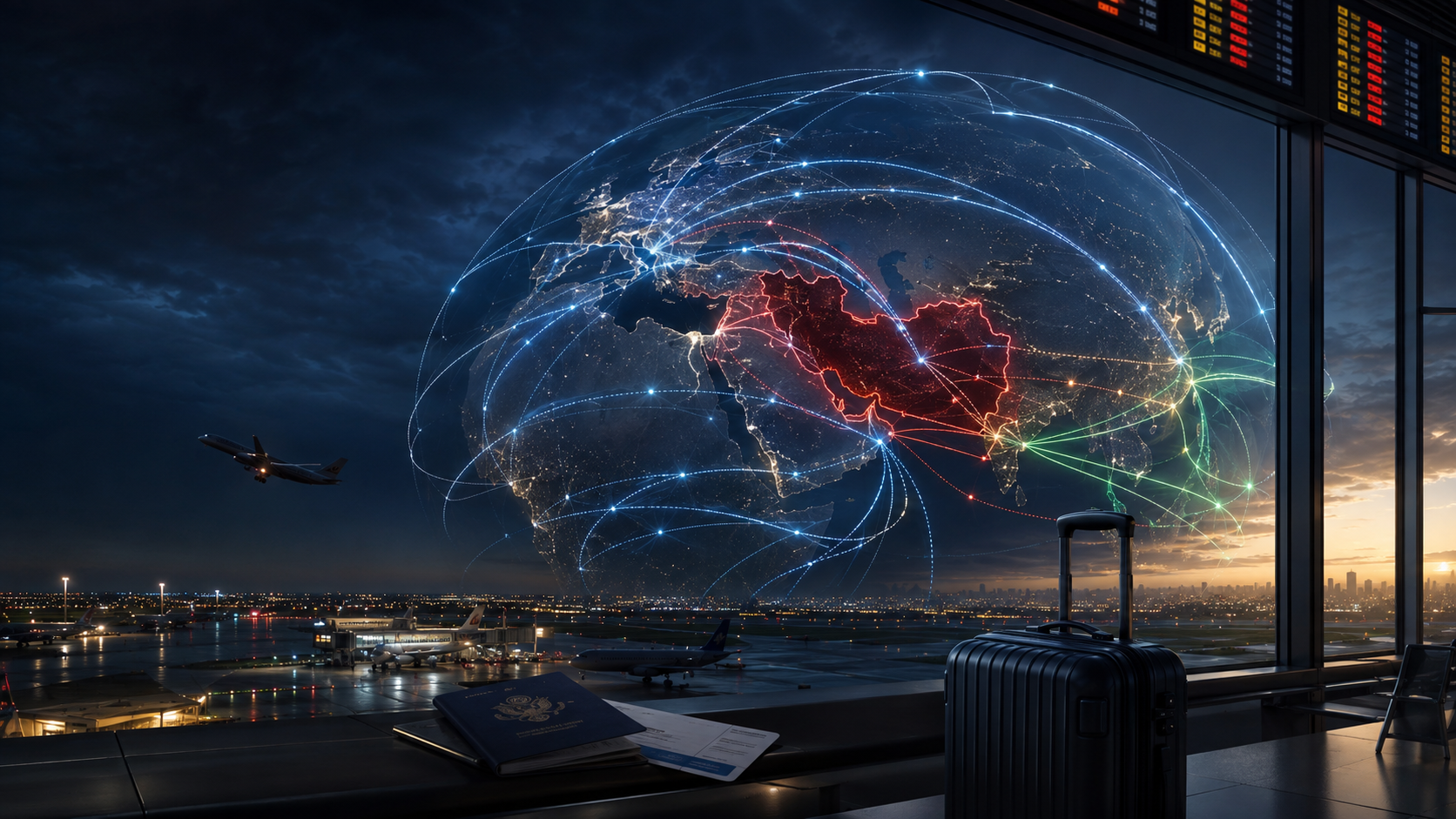
Something shifted in global travel in the last week of February 2026 — and it happened almost overnight. When the United States and Israel launched coordinated airstrikes against Iran on February 28, triggering a war that would close the Strait of Hormuz and ignite the worst energy crisis in modern history, the world’s travel industry — which had only just celebrated a full post-pandemic recovery — was thrown into a crisis it had never seen before.
This is the story of how geopolitics rewrote the travel playbook, where the world is going instead, and what the next few months are likely to bring.
⛽ The Energy Shock That Started It All
The closure of the Strait of Hormuz — through which around 20% of the world’s oil trade passes — combined with Iranian attacks on energy infrastructure across Gulf Cooperation Council countries led to a disruption in global oil supplies that the International Energy Agency characterized as the “largest supply disruption in the history of the global oil market.” aol
Brent crude surged to nearly $120 per barrel in the opening week of the conflict, then settled above $100 per barrel — a cumulative increase of more than 40% over pre-war levels. At the same time, violent sell-offs hit major global equity markets amid mounting fears of stagflation reminiscent of the turbulent 1970s. Refinery29
When the war began, all shipping through the Strait of Hormuz was effectively halted, removing roughly one-fifth of the world’s oil and gas supply from the market. Fuel prices throughout the world spiked and will likely remain elevated as long as conflict persists. Coveteur
For aviation, the impact was even more severe. Jet fuel prices, which were around $85 to $90 per barrel before the attack on Iran, soared to between $150 and $200 — prompting airlines from Qantas to SAS to Air New Zealand to announce airfare hikes and suspend their financial outlooks for 2026 due to uncertainty over the conflict. Wikipedia
✈️ What Happened to Airfares
The numbers tell an unambiguous story. The average round-trip international flight hit $1,097 on April 20 — a 42% increase from $774 on February 23, just before the Iran war started, and a 14% rise from a year earlier. Domestic fares in the US were not spared either, rising 8% to $361 on average, and up 19% from a year ago. Wikipedia
In April 2026, the United States Labor Department reported that domestic airfares had surged by 21% compared to the previous year. Airlines responded not just by raising ticket prices but by dramatically increasing baggage fees, adding fuel surcharges, and using dynamic pricing algorithms that pushed the number of frequent flyer miles required for a standard seat sharply higher — eroding the value of loyalty points that millions of travelers had been hoarding for years. CNBC
Across Europe, Spain urged travelers to book flights immediately, warning that ticket prices remained temporarily stable only because airlines were still operating on previously purchased fuel. That buffer, it said, was rapidly disappearing — and as airlines began purchasing fuel at elevated market prices, ticket costs would rise sharply. Middle East Council on Global Affairs
The disruption is costing the tourism sector at least $600 million a day in lost international visitor spending, according to the World Travel & Tourism Council, which before the conflict had forecast travelers would spend $207 billion in the Middle East region in 2026 alone. Congress.gov
🗺️ Where Travelers Are Going Instead
The crisis did not kill the desire to travel. It redirected it — sharply and in ways that reveal a great deal about how people make decisions under uncertainty.
The rise of “Plan B” travel. Travelers are planning summer holidays with half an eye on the Iran war and rising airfares, staying closer to home, lining up alternative destinations, and keeping travel options open. Spain, Greece, and Portugal have emerged as preferred European alternatives — seen as safe, accessible, and reachable without transiting through disrupted Middle Eastern hubs. CNBC
Train travel and staycations are surging. Data shows that travelers are changing their plans to accommodate rising prices and uncertainty — changing destinations, leaning heavily towards train travel this summer, staycations, and places much closer to home rather than long-distance plane travel. aol
The Caribbean is having a moment. Travel agents report demand for long-haul direct routes to the Caribbean is “off the charts” in the near term — particularly the Dominican Republic and Jamaica — as travelers seek sun destinations that do not require transiting through disrupted Middle Eastern hubs. Skift
Domestic tourism is booming. Americans are not necessarily traveling less, but they are traveling differently — staying closer to home, planning shorter itineraries, or taking trips that combine work and leisure savings in one booking. Domestic demand is holding up even as international uncertainty grows. The same trend is playing out globally: in India, hill stations in Himachal Pradesh and Uttarakhand, as well as Kashmir, Ladakh, and the northeast, are drawing increased interest. Udaipur recorded a 69% year-on-year increase in flight bookings, followed by Jodhpur, Bagdogra, and Srinagar. Travel And Tour WorldSkift
The Middle East is losing its tourism momentum. Before the war, Dubai had welcomed almost 20 million international tourists in 2025 and Qatar’s capital Doha was named the Gulf Tourism Capital for 2026. The conflict has jeopardised both the connectivity and stability these destinations depend on to remain attractive. Oxford Economics forecasts that a two-month escalation — which is already the case — could lead to a drop of as much as 27% in international tourist arrivals to the Middle East for the full year, with GCC countries potentially seeing a decline of up to 26% where 8% growth had been expected. Al Jazeerayahoo
Hotels and Airbnb are benefiting from the flight aversion. Hotel groups have actually fared better than airlines — Marriott and Hilton raised their annual RevPAR forecasts, both betting on a rebound in US domestic travel. Airbnb increased its full-year guidance with revenue expected to grow in the low-to-mid teens, as travelers pivot from flying to staying closer to home. World Economic Forum
🔮 Predictions: What the Next Few Months Look Like
Based on the trajectory of the conflict, the energy market, and shifting traveler behavior, here is where the evidence points for the summer and autumn of 2026:
1. Airfares will keep climbing before they stabilize. The airlines still operating on pre-war fuel contracts are about to reprice. Inflation is now projected to hit 4% in 2026 — 1.2% higher than previously expected — and year-over-year increases in domestic summer fares of 16–19% are already being recorded. Expect the full pass-through of jet fuel costs to land in ticket prices by July. The window to lock in relatively lower fares is closing fast. Wikipedia
2. Europe’s summer season will be reshaped, not ruined. The redirection of travel toward Spain, Portugal, Greece, and Italy will likely generate a strong summer for Southern Europe — but it will also mean overcrowding at popular destinations, putting upward pressure on hotel prices and experiences at well-known sites. Budget travelers may need to look beyond the usual hotspots.
3. Train travel will have a structural boom. The shift toward rail in Europe is not just a summer workaround — it is likely to become a lasting behavioral change. With Eurostar, Trenitalia, and national rail networks already seeing surging bookings, the infrastructure conversation in Europe is accelerating. Expect new route announcements and capacity expansions in the second half of 2026.
4. Loyalty programs will be permanently repriced. The devaluation of airline miles triggered by fuel surcharges is unlikely to fully reverse even if oil prices stabilize. Airlines have discovered they can charge more per redemption, and most will not walk that back. Travelers who hoarded points for a “someday” trip should treat this as an urgent signal to use them — or lose meaningful value.
5. The bleisure and “slow travel” trend will accelerate. Airlines are shifting their focus toward domestic routes because booking patterns are more predictable, and destinations are increasingly targeting domestic travelers and business-leisure visitors rather than international tourists. This means more packages designed for longer stays in fewer places — a travel philosophy that the pandemic introduced and that the energy shock is now cementing. Travel And Tour World
6. Middle Eastern tourism will need years, not months, to recover. Even if a ceasefire were declared today, the psychological damage to the region’s tourism brand — particularly for Dubai and Doha — would take time to repair. Airlines will be slow to restore routes. Travelers will be slower still to rebook. The 2027 tourism season is the more realistic recovery target for the Gulf.
7. The travel insurance industry will be permanently changed. The combination of geopolitical risk, energy volatility, and flight disruptions is making “cancel for any reason” policies far more valuable — and far more expensive. Expect travel insurance premiums to climb 20–30% by Q3 2026 as insurers reprice their exposure to conflict-related disruptions.
The Bottom Line
The Iran war did not stop people from wanting to see the world. But it fundamentally changed the calculus of how they get there, where they go, and what they are willing to pay. The travelers who adapt fastest — locking in fares now, choosing rail over air where possible, looking at overlooked destinations that benefit from the redirection of tourist flows — will have the best experiences this year. Those who wait for certainty may find the choices made for them by empty seats and empty wallets.
Travel has always been resilient. What changes is the map.
This post is for informational and editorial purposes only. Travel conditions, airfares, and geopolitical situations are subject to rapid change. Always check government travel advisories before booking.
For a broader look at where travel risk is currently concentrated, see our traveller’s safety guide to cities requiring extreme caution.


Leave a Reply